The short version
The best savings app depends on whether you want money moved for you. Qapital puts money away through rules, from $3 a month, and Rocket Money lists an automated savings plan under Premium. Monarch, YNAB, Goodbudget and PocketGuard track a goal against your accounts or categories. Wonderful plans savings from each paycheck and shows the month you will reach a goal, without moving money.
- 1
Qapital: Saving that happens on its own, through rules
- 2
Monarch Money: Goals that follow the accounts you save in
- 3
YNAB (You Need A Budget): Saving by category, with an amount for each date
- 4
Goodbudget: Envelopes for goals, with a free plan
- 5
PocketGuard: A dated goal with a planned monthly amount
- 6
Wonderful: Couples who want savings planned from every paycheck
- 7
Copilot Money: Apple users who want goals beside a net worth view
- 8
Rocket Money: People who want an automated savings plan under one app
At a glance
| App | Best for | Price | Free trial | Works on | How a goal works |
|---|---|---|---|---|---|
| Qapital | Saving that happens on its own, through rules | $3/mo | "Qapital costs $0 for 30 days | iPhone, Android | Goals plus Rules that save for you[9] |
| Monarch Money | Goals that follow the accounts you save in | $14.99/mo or $99.99/yr | The pricing page says "Your first week is on us | iPhone, Android, Web | Target amount, planned monthly amount, accounts assigned[1] |
| YNAB (You Need A Budget) | Saving by category, with an amount for each date | $14.99/mo or $109/yr | The pricing page says a 34-day free trial | iPhone, Android, Web | Target on a category, amount worked out for a date[2] |
| Goodbudget | Envelopes for goals, with a free plan | Free, or $10/mo or $80/yr | None stated | iPhone, Android, Web | Annual and goal envelopes with a due date[3] |
| PocketGuard | A dated goal with a planned monthly amount | $6.25/mo or $74.99/yr | A 7-day free trial on each plan | iPhone, Android, Web | Target amount, date and planned contribution[4] |
| Wonderful | Couples who want savings planned from every paycheck | $14.99/mo or $99/yr | A free week | Web | Goals show the month you'll reach them[47] |
| Copilot Money | Apple users who want goals beside a net worth view | $13/mo or $95/yr | The App Store and the FAQ say one month free for new users | iPhone, Web, Mac | Savings goals[51] |
| Rocket Money | People who want an automated savings plan under one app | Free, or $15/mo | The help center says new Premium members get a 7-day free trial | iPhone, Android, Web | Premium: Smart Savings or Custom Savings[53] |
- Qapital$36
- PocketGuard$74.99
- Goodbudget$80
- Copilot Money$95
- Wonderful$99
- Monarch Money$99.99
- YNAB (You Need A Budget)$109
- Rocket Money$180
The cheapest way to pay for a year on each app's own page. Qapital's annual prices weren't on the page, so twelve months of Basic is shown. Goodbudget's free plan is not charted. Rocket Money's Premium price is not fixed, so only Premium+ at $15 a month is charted. Copilot's bar is its App Store yearly price ($95); its website shows $109. Wonderful's price covers both partners.
Tracking a goal or moving the money
Two kinds of app answer a search for a savings app. A tracking app keeps a goal as a number: you say what you are saving for and by when, and it shows progress, usually from the balance of an account you point it at. You still make the transfer yourself, or you don't. A moving app does the transfer for you, through rules or a split of your paycheck.
The first costs you attention. The second asks you to trust the app with a connection to your accounts and, in some cases, with the money itself. Neither is wrong. People who forget to move money do better with the second; people who like to see every dollar placed do better with the first. If you are not sure how big the goal should be, the emergency fund guide sizes the usual first one, and the guide to sinking funds covers costs that come a few times a year.
What to save for first
An app can only plan a goal you have named, so start there. Most people end up with three kinds, and they work differently in an app.
- A cushion. Money for the month something goes wrong. It has no date, so a tracking goal with a target amount fits it, and it is the one to fill first. The emergency fund guide works out a size.
- Costs you can see coming. A trip, a wedding, a deposit, a holiday. These have a date, so the app's date math helps. $1,200 for the holidays by December, saved over 12 months, is $100 a month; $6,000 for a down payment in 24 months is $250.
- Yearly bills. Car registration, insurance paid once a year, annual subscriptions. Set aside a twelfth each month and the bill never feels like a surprise. The guide to sinking funds covers it, and saving for a house covers the biggest dated goal most people have.
Goodbudget calls the second and third kinds goal envelopes and annual envelopes, and YNAB puts both on a category target; either way the idea is the same. Pick the amount that fits what is left after bills, not what feels right, and let the date do the rest. The how much of my paycheck should I save tool starts from your pay.
What each app asks you to do
The real difference between these apps is the work they leave to you.
- Qapital: Set a goal and a rule or a paycheck split; the pages say it saves on its own.[9]
- Monarch: Make a goal, plan a monthly amount and assign the account you save in; progress follows the balance.[1]
- YNAB: Set a target on a category and fund the category when it reminds you.[2]
- Goodbudget: Give an envelope an amount and a due date, then fund it in each budget period.[3]
- PocketGuard: Enter a target, a date and a planned contribution, then assign an account.[4]
- Wonderful: Plan each paycheck, name the goal, and see the month you will reach it.[47]
- Copilot: Track a goal; it holds no money and connects read-only.[50][51]
- Rocket Money: Turn on the automated savings plan on Premium.[5]
If you already move money on the day you are paid, a tracking app is enough and costs less attention than it sounds. If you tend to spend what is in checking, the moving apps earn their price. Either way, the habit that matters is moving the money on payday, before there is anything to talk yourself out of.
How we compared
For a savings app, these are the things that matter:
- How a goal works. A target amount, a date, a planned monthly amount, or only a balance to watch.
- Whether money moves. What the app's own pages say about transfers, and where we say "not stated."
- What it costs. The cheapest way to pay for a year, and what a free plan leaves out.
- Who holds the money. Whether the app is a bank, and what it says about FDIC insurance.
- Whether two people can save together. Shared goals, shared logins, what a partner sees.
Every fact comes from the app's own pricing and goal pages, its App Store and Google Play listings and their reviews, and the FDIC and CFPB for insurance, read on October 27, 2026. Each is numbered to its source at the end. Where a page doesn't say, this page says so.
1. Saving that happens on its own, through rules
Qapital
$3/mo· iPhone, Android
What it is
A goal and automation app that puts money away for you through rules and paycheck splits, with investing and a debit card on higher plans.
Why it's on this list
Qapital is built around the idea that saving works better when you don't have to decide each time. Its home page says it will put money away automatically, and its pricing page lists automatic saving through Rules and saving a portion of your paycheck the moment you get paid.[9]
Basic is $3 a month and includes unlimited goals; Complete is $8 and adds investing and a debit card; Premier is $12.[9]
Ideal for: People who want the transfers to happen without remembering.
What it does
- "Put money away automatically while you live your life. Just set a goal and watch your savings grow."[8]
- Saves automatically with customizable triggers called Rules, and can save a portion of your paycheck the moment you get paid.[9]
- Unlimited goals on every plan, with transfers between goals.[9]
- Complete and Premier add ready-made investment portfolios and a Visa debit card.[9]
Who holds the money
"Qapital is a fintech company, not an FDIC-insured bank"; the checking account and debit card come from Lincoln Savings Bank, Member FDIC.[8][9] On Basic, the Save account funds are held "in an umbrella fiduciary account for the benefit of Qapital's users."[9] Read that page before you move a large amount in.
Good
Not so good
- "Qapital is a fintech company, not an FDIC-insured bank"; the checking account and debit card come from Lincoln Savings Bank, Member FDIC.[8][9]
- On Basic, the Save account funds are held "in an umbrella fiduciary account for the benefit of Qapital's users."[9]
- iPhone and Android only; the pages opened mention no web app.[8]
2. Goals that follow the accounts you save in
What it is
A paid budgeting and net worth app that pulls every account into one place and lets a partner join under the same subscription.
Why it's on this list
Monarch's goals are made with a target amount, a planned monthly contribution and a custom image. You give each account a purpose by assigning it to a goal, and progress is tracked automatically.[1] You can make as many goals as you need and prioritize them.
The page says you can save toward a big life event or pay down a loan, and that you can assign a cash or investment account.[1] It doesn't mention a target date, or whether money moves.
Ideal for: People who want goals sitting beside the rest of their accounts.
What it does
- Connects bank accounts, credit cards, loans, investment accounts and real estate, through 13,000+ financial institutions.[13]
- Tracks net worth across all connected accounts.[11][13]
- Sorts transactions automatically and searches across every account in one list.[11][13]
- Two ways to budget: Flex, which splits spending into fixed, flexible and non-monthly buckets and gives one main number to watch, or Category budgeting.[11][16]
- Rollovers: money left in a category carries into the next month, to cover bills that do not come every month.[16]
For two people
Two people can fund a shared goal even when their money sits in separate accounts.[15] A partner joins under the same subscription.[14][15]
Good
- A partner joins under the same subscription at no extra cost, with a separate login.[14][15]
- Two people can fund a shared goal even when their money sits in separate accounts.[15]
- Works on iPhone, iPad, Android and the web.[11][12][13]
- Rated 4.9 on the App Store (116K ratings) and 4.8 on Google Play (26.1K reviews).[11][12]
Not so good
- No free plan after the first week.[10][11]
- Paid monthly it is $14.99, which is $179.88 over twelve months, against $99.99 billed yearly.[10]
- Forecasting, several income sources and deeper investment tracking sit in the Plus tier. The App Store shows Plus at $199.99 a year; the pricing page lists no Plus price.[10][11]
- A partner sees all accounts and transactions. The couples page describes no way to keep one account private.[14][15]
Pricing
- Monthly[10][11]$14.99 a monthPricing page and App Store both show $14.99. The pricing page does not say which tier it is.
- Yearly[10][11]$99.99 a yearBilled yearly. The pricing page names two tiers, Core and Plus, but lists only these two prices.
- Yearly Plus[10][11]$199.99 a yearShown only as an in-app purchase on the App Store. The pricing page says Plus adds forecasting tools, tracking several income sources like a small business, and deeper investment tracking.
- The pricing page says "Your first week is on us." The App Store says the app is free to try for 7 days before a monthly or annual membership is billed. Neither says whether a card is needed.[10][11]
- No free plan is listed on the pricing page or the App Store. The only free access is the first week.[10][11]
3. Saving by category, with an amount for each date
What it is
A paid budgeting app built on a method: give every dollar a job before you spend it.
Why it's on this list
In YNAB a goal is a target on a category. Its goal tracking page says you decide how much money you want to spend and YNAB will calculate how much you need to save each week, month, year or by a custom date.[2]
It reminds you how much to add to a category and shows color-coded progress bars, and you can snooze a target for the month. It doesn't say it moves money, so you fund the category yourself.[2]
Ideal for: People who want to decide the amount and the date, and do the saving by hand.
What it does
- The method: for every dollar, ask "What's it for?" Plan for now (before the next paycheck), for later (non-monthly bills like car repairs), and for ease (get a month ahead).[23]
- Bank import links accounts and brings in transactions automatically. Apple Card import is also listed.[22]
- Targets: set spending and savings goals per category and track progress at a glance.[22]
- Loan Planner: shows how much interest and time you save for each extra dollar paid toward debt.[22][24]
- Reports on spending, such as average grocery spend, and on net worth over time.[22][24]
Sharing
One subscription can be shared with up to 5 more people, six in all, at no extra cost.[21]
Good
- A written method, not just a tracker: the app is built around planning before spending.[23]
- One subscription covers up to six people at no extra cost.[21]
- A 34-day trial with no card when you sign up on the site, and a free 365-day trial for college students.[21]
- Rated 4.8 on the App Store (62K ratings) and 4.6 on Google Play (25.4K).[24][25]
Not so good
- No free plan after the trial.[21]
- Paid monthly it is $14.99, which is $179.88 over twelve months, against $109 billed annually.[21]
- The website says a 34-day trial and the App Store says 30 days.[21][24]
- The method asks you to plan each dollar before you spend it, which the company's method page presents as the whole point of the app.[23]
4. Envelopes for goals, with a free plan
Goodbudget
Free, or $10/mo or $80/yr· iPhone, Android, Web· App Store 4.6 (13,516)[34]
What it is
An envelope budgeting app for the web, iPhone and Android where you divide income into virtual envelopes and share the budget across devices.
Why it's on this list
Goodbudget is envelope budgeting with two saving envelopes. Annual envelopes are for yearly costs like holiday gifts or property taxes; goal envelopes are for one-time costs like a wedding or a new car. You give each a budget amount and a due date.[3]
Goodbudget breaks the goal into equal parts based on your budget period and due date, and you fund the envelope as part of your regular budget.[3] The help article doesn't say anything moves between bank accounts. It shows a last-updated date of February 4, 2020.
Ideal for: People who like funding envelopes by hand and want a free plan to start.
What it does
- Envelope budgeting: you divide income into category envelopes, spend from the matching envelope and stop when it is empty, with no physical cash.[36]
- The free plan has 10 regular envelopes and 10 annual or goal envelopes; Premium removes the cap.[29][30]
- Syncs and shares a budget across iPhone, Android and the web, with data backed up to Goodbudget's website.[32][34]
- Automatic bank sync is a Premium feature and works with US banks only. The free plan is manual entry.[29][30]
- Reports in the app: spending by envelope (a pie chart), income versus spending, and debt progress; more reports on the web.[34]
What the free plan allows
A free plan exists. It has no bank sync, one account, 20 envelopes in all (10 regular and 10 annual or goal), two devices and a year of history. The App Store listing calls it ad-free.[29][30][34]
Good
Pricing
- Free[29][30]FreeCalled "Free Forever" on the page. 10 regular envelopes, 10 annual or goal envelopes, 1 account, 2 devices, 1 year of history, debt tracking, community support.
- Premium[29][30]$10 a month · $80 a yearAdds automatic bank sync (US banks only), unlimited envelopes and accounts, 5 devices, 7 years of history and email support.
5. A dated goal with a planned monthly amount
What it is
A paid budgeting app for iPhone, Android and web that links bank accounts and shows how much is safe to spend after bills, goals and essentials.
Why it's on this list
A PocketGuard goal has a target amount, a target date and a planned contribution. You assign accounts to goals and the page says progress is tracked automatically; a finished goal moves to an archive where you can review its history.[4]
Its budget view shows what is left to spend after bills, goals and essentials.[38][42] The goals page doesn't say whether funds are transferred.
Ideal for: People who want a goal with a date and a planned monthly amount, and a lifetime price option.
What it does
- "Leftover": what you can still spend after bills, goals and essentials.[38][42]
- Budget with zero-based, envelope or category methods, with rollovers for unspent or overspent money.[38][40]
- Pace: predicts how much you will have left at month's end from your spending habits.[38][42]
- Finds recurring charges and subscriptions automatically, and the listing mentions a built-in bill negotiation service.[38][42]
- Transaction rules that match merchant names, keywords, amounts, categories or accounts.[42]
Price
A one-time $149.99 lifetime option besides subscriptions.[39] Yearly plan is $74.99, about $6.25 a month.[39]
Good
Not so good
- No free plan; the app requires the trial or a paid plan.[39]
- Monthly billing is $12.99, about double the yearly rate per month.[39]
- No partner or shared login is described on the pages opened.[38][39][40][41]
- App Store reviewers in 2025 and 2026 report being charged at the start of the trial, and a trial that does not appear in App Store subscription settings.[43]
6. Couples who want savings planned from every paycheck
Wonderful
$14.99/mo or $99/yr· Web
What it is
A budgeting app for couples who keep their own money, and for one person: each of you connects your own bank, chooses what the other sees, and every paycheck gets a plan.
Why it's on this list
Savings is not why most people pick Wonderful, so it sits sixth. It plans every paycheck for bills, spending and saving before it lands[47], and its savings goals show the month you'll reach them.[47]
It's a planner and tracker, not a savings account, and it gives no investment advice.[47] One subscription covers both partners.[45]
Ideal for: Couples who want saving planned from each paycheck, with goals that say when you will get there.
What it does
- Every paycheck gets a plan for bills, spending and saving before it lands.[47]
- Banks connect through Plaid and every charge is sorted into a category.[46][47]
- Mine, yours and ours: each charge counts for the person or the pair it belongs to.[47]
- Finds recurring charges and subscriptions, lists what's due before your next paycheck, and flags a bill that comes in higher than usual. It doesn't cancel them for you.[47]
- Texts you by iMessage when a bill is charged twice, a price goes up or a refund lands, and you can text it questions.[47]
- Savings goals show the month you'll reach them.[47]
- Net worth for each of you and for both, from the balances your banks send, with its line over time.[47]
- Life events like getting married come step by step, with the deadlines.[47]
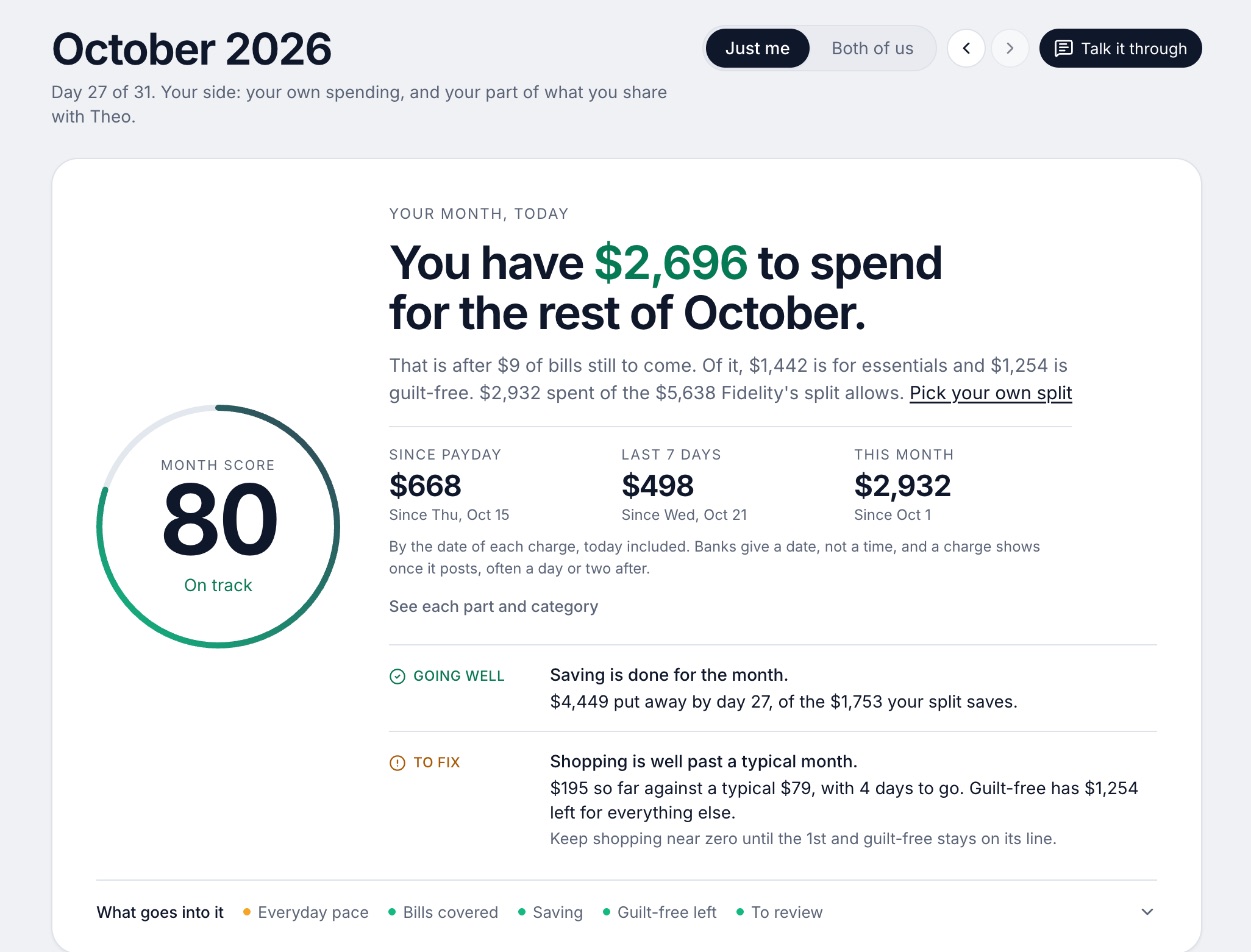
Good
7. Apple users who want goals beside a net worth view
Copilot Money
$13/mo or $95/yr· iPhone, Web, Mac· App Store 4.8 (31K)[51]
What it is
A paid budgeting and net worth app for Apple devices and the web, with an AI money assistant and one plan that does everything.
Why it's on this list
Copilot's App Store listing mentions savings goals and a cash flow view. Savings goals and a cash flow view.[51] The pages opened don't describe target dates or monthly amounts.
The FAQ says it connects through read-only integrations, so a goal is tracked, not funded.[50][51]
Ideal for: Apple users who want savings goals next to net worth and a polished app.
What it does
- Money Assistant: an AI you can ask about your money. The page says it "always asks before acting." It can fix transactions, run instructions in the background and flag spending trends with budget suggestions. The App Store says it is available only on iPhone.[48][51]
- Connects to 16,000+ US institutions through read-only integrations, with direct links for Venmo, Apple Card and Coinbase.[50][51]
- Sorts transactions automatically, and the assistant can change a category or match a refund to its purchase. You can set your own categories with colors and emojis.[48][51]
- Adaptive budgets that adjust to your spending.[51]
- Tracks spending, investments, net worth and subscriptions.[48][51]
For two people
Households are marked "Coming soon" and partner invites "coming this fall" on the home and pricing pages. Once live, the pages say up to 3 people share one subscription at no extra cost with full access.[48][49]
Good
Not so good
- No Android app. The pages list iPhone, iPad, Mac and web only.[48][49][50]
- Sharing with a partner is not live. Households are marked "Coming soon."[48][49][50]
- No free plan after the trial.[50]
- The website and the App Store show different prices: $18 a month or $109 a year (shown as $9 a month) on the site, $13.00 and $95.00 on the App Store.[49][51]
Pricing
- Website, monthly[49]$18 a monthBilled monthly. The pricing page calls it "One simple plan" (checked in a browser 10/27).
- Website, yearly[49]$109 a yearShown as $9 a month, billed yearly, "instead of $119", and labeled a limited time offer.
- App Store, monthly[51]$13 a monthListed as $13.00 on the App Store, which is not what the pricing page shows.
- App Store, yearly[51]$95 a yearListed as $95.00 on the App Store.
8. People who want an automated savings plan under one app
What it is
An app that finds your subscriptions, can cancel them and negotiate bills for you, and tracks spending and budgets, with a free plan and two paid ones.
Why it's on this list
Rocket Money's home page lists an Automated Savings Plan under Premium and says its autopilot learns your habits and saves the right amount at the right time while helping you avoid overdraft fees.[5] Its features list Financial Goals with Smart Savings or Custom Savings on Premium.[53]
The home page says banking services are provided by nbkc bank, Member FDIC, and doesn't say whether savings are held there.[5]
Ideal for: People who want to look at an automated savings feature inside a broader money app.
What it does
- Finds recurring subscriptions in one place. On Premium, a team cancels them for you; its cost article says this usually takes 2 to 10 days. On Free you cancel them yourself.[53]
- Negotiates cable, phone and insurance bills for a success fee of 35% to 60% of the first year's savings.[53][54][55]
- Tracks upcoming bills, net income and spending, with automatic categories.[53]
- Custom budgets: two custom category budgets on Free, unlimited custom budgets and categories on Premium.[53]
- Premium adds transaction rules, splits, notes, tags, manual transactions and CSV export.[53]
What Premium costs
The price is not fixed: the learn article says $7 to $14 a month, the help center gives no numbers, and the App Store lists purchases from $2.99 to $9.99.[53][54][56] Reviewers also object to a percentage of savings taken on top of a subscription, which is about bill negotiation, not the savings plan.[58]
Good
- A free plan exists and covers subscription tracking, bills and basic budgets.[53]
- Cancels subscriptions for you on Premium and negotiates bills.[53]
- Large installed base: 403K ratings on the App Store at 4.5 stars and 141K on Google Play at 4.5.[56][57]
- Premium is a sliding scale you pick yourself, with a 7-day trial.[53][54]
Not so good
- The price is not fixed: the learn article says $7 to $14 a month, the help center gives no numbers, and the App Store lists purchases from $2.99 to $9.99.[53][54][56]
- Bill negotiation costs 35% to 60% of the first year's savings for Free and Premium members.[53][54]
- On Free you cancel subscriptions yourself. Hands-off cancelling is Premium.[53][55]
- The free plan allows two custom category budgets, so a full budget needs Premium.[53]
Pricing
- Free[53]FreeMobile only. Tracks subscriptions and upcoming bills, with two custom category budgets.
- Premium[53][54][56]Pay what you think is fair, "typically $7 to $14 per month, subject to change," per the learn article. The help center says the price varies by platform and gives no numbers. The App Store lists Premium purchases from $2.99 to $9.99 without billing periods.
- Premium+[53][54][56]$15 a monthA fixed $15 a month plus tax. Adds Rowan, an AI assistant that works through text messages, and no fee on bill negotiation.
- The help center says new Premium members get a 7-day free trial, then the subscription continues at the price chosen at sign-up. The learn article states no trial.[53][54]
- A free plan exists. It links accounts (not in real time), tracks subscriptions but you cancel them yourself, tracks upcoming bills, and shows spending breakdowns.[53]
Fees and FDIC insurance
Read the price on each app's own page; the table above has what we found. On insurance, the FDIC says coverage is automatic whenever a deposit account is opened at an FDIC-insured bank or financial institution.[6] The CFPB, in a report on payment apps, says deposit insurance only protects against the failure of the bank or credit union and does not protect the customer against the failure of the nonbank company itself, and that a claim of pass-through coverage is extremely difficult to verify before a bank fails.[7]
So where an app holds your money matters. An app that only tracks, like Copilot with its read-only connections, isn't holding any. An app that moves money should tell you which bank holds it, and Qapital does: its page names Lincoln Savings Bank, Member FDIC.[8][9] If you need the answer for a specific app, ask it, or call the FDIC at 1-877-ASK-FDIC, before relying on it.
Saving as a couple
Saving together raises two questions: can both of you see the goal, and who puts in what. Qapital's Basic plan lists saving for shared goals with a partner and keeping track of who paid for what.[8][9] YNAB shares one subscription with up to six people.[21] Monarch lets two people fund a shared goal even when their money sits in separate accounts.[15] Wonderful covers both partners for one price.
If you split the saving by income rather than 50/50, the fair split calculator works out each person's share, and the couples roundup covers what a partner sees in each app.
How to choose
Decide first whether you want to track or have money moved, then check whether a goal takes a date, what the price is, and who holds the money.
Choose Qapital if you:
- Forget to move money yourself
- Want rules or a paycheck split to do it
- Are fine with an app that isn't a bank
Choose Monarch Money if you:
- Already save in a cash or investment account
- Want goals beside net worth and budgets
- Have a partner and want one subscription
Choose YNAB (You Need A Budget) if you:
- Want an amount worked out for a date
- Will fund the category by hand
- Like planning every dollar
Choose Goodbudget if you:
- Like envelopes
- Want a free plan to start
- Are happy to enter some spending by hand
Choose PocketGuard if you:
- Want a target, a date and a planned amount
- Like a one-time lifetime price
Choose Wonderful if you:
- Are a couple who keep your own money
- Want saving planned from each paycheck
- Don't need the app to move money
Choose Copilot Money if you:
- Use Apple devices
- Want goals beside net worth
Where Wonderful fits, and where it doesn't
We make Wonderful, and it is not a savings app. It is a budgeting app for couples who keep their own money: each of you connects your own bank, chooses what the other sees, and every paycheck gets a plan. Savings goals that show the month you'll reach them are part of that.
If you want money moved for you, Wonderful is the wrong tool: use Qapital, or look at Rocket Money's plan. If you want goals tied to the account you save in, Monarch does it. If you are a couple who wants saving planned from each paycheck, with bills split between you, that is where Wonderful fits. It has no free plan after the first week, and it runs in the browser. See free budgeting apps if cost decides it.
Questions people ask
What are the best apps for savings goals?
It depends on whether you want to track a goal or have money move for you. Monarch, YNAB, Goodbudget, PocketGuard, Copilot and Wonderful track a goal against your accounts, categories or paychecks. Qapital describes saving automatically through rules, and Rocket Money lists an Automated Savings Plan under Premium.
What are the best money saving apps?
There isn't one. An app that tracks suits you if you will make the transfer yourself and want to see progress. An app that moves money suits you if you want it automatic, and then it is worth reading who holds the money and how the app describes FDIC insurance.
Is there an app to save money automatically?
Qapital says it will put money away automatically, through Rules and by saving a portion of your paycheck when you get paid, from $3 a month. Rocket Money's home page says its autopilot learns your habits and saves the right amount at the right time. Monarch, YNAB, Goodbudget and PocketGuard describe tracking and planning, and their goal pages don't say they transfer money.
Does a savings app move my money or just track it?
Copilot's FAQ says its integrations are read-only, so a goal there is tracked. Monarch and PocketGuard assign an account to a goal and track progress from its balance. YNAB reminds you how much to add to a category. Qapital and Rocket Money describe moving money on their own.
Is the money in a savings app FDIC insured?
Only if it is held at an FDIC-insured bank. The FDIC says coverage is automatic when a deposit account is opened at an insured bank. Qapital's page says it is not an FDIC-insured bank and names Lincoln Savings Bank, Member FDIC, for its checking account and debit card. The CFPB says deposit insurance protects against the failure of the bank, not the app.
How do I save for a goal by a date?
Divide what you need by the months left: $3,000 in 12 months is $250 a month. YNAB says it calculates how much to save each week, month, year or by a custom date. Goodbudget divides a goal into equal parts by budget period and due date. PocketGuard takes a target amount, a target date and a planned contribution.
What is the best savings app for couples?
Qapital lists shared goals and who-paid-for-what tracking with a partner on its $3 Basic plan. YNAB shares one subscription with up to six people. Monarch includes a partner at no extra cost, and Wonderful covers both partners for one price. For privacy and splitting, see the couples roundup.
Is there a free app to save money?
Goodbudget has a free plan with 10 regular envelopes, 10 annual or goal envelopes and one account. The others charge after a trial: 30 days for Qapital, 34 for YNAB, 7 for PocketGuard and a week for Monarch and Wonderful. Rocket Money's free plan doesn't include its automated savings or goals.
How much should I save each month?
The answer depends on your take-home pay and what you are saving for. Start by putting a number on the goal, divide by the months left, then compare it with what is left each month after bills. The how much of my paycheck should I save tool does the arithmetic with your pay, and the emergency fund guide sizes the first goal.
Sources
59 sources · read October 27, 2026
Every number on this page comes from monarch.com, ynab.com, goodbudget.com and 15 more. If a source has changed since, the source is right.
- 1Monarch, Goalsmonarch.com
- 2YNAB, Goal Trackingynab.com
- 3Goodbudget help, Set Goals and Track Your Progress with More Envelopesgoodbudget.com
- 4PocketGuard, Savings goalspocketguard.com
- 5Rocket Money home pagerocketmoney.com
- 6What's covered by FDIC insurance (FDIC)fdic.gov
- 7Analysis of deposit insurance coverage on funds stored through payment apps (CFPB)consumerfinance.gov
- 8Qapital home pageqapital.com
- 9Qapital pricingqapital.com
- 10Monarch pricingmonarch.com
- 11Monarch on the App Storeapps.apple.com
- 12Monarch on Google Playplay.google.com
- 13Monarch home pagemonarch.com
- 14Monarch for couplesmonarch.com
- 15Monarch collaborationmonarch.com
- 16Monarch budgetingmonarch.com
- 17Monarch planningmonarch.com
- 18Apple public review feed for Monarchitunes.apple.com
- 19Monarch help: Monarch for Couples and Householdshelp.monarch.com
- 20Trustpilot, www.monarchmoney.comtrustpilot.com
- 21YNAB pricingynab.com
- 22YNAB featuresynab.com
- 23The YNAB methodynab.com
- 24YNAB on the App Storeapps.apple.com
- 25YNAB on Google Playplay.google.com
- 26Apple public review feed for YNABitunes.apple.com
- 27YNAB: Using YNAB as Partnerssupport.ynab.com
- 28Trustpilot, ynab.comtrustpilot.com
- 29Goodbudget pricing (signup page)goodbudget.com
- 30Goodbudget help: Subscribe to Goodbudgetgoodbudget.com
- 31Goodbudget refunds and cancellationsgoodbudget.com
- 32Goodbudget home pagegoodbudget.com
- 33Goodbudget help indexgoodbudget.com
- 34App Store listing, Goodbudgetapps.apple.com
- 35App Store reviews, Goodbudgetapps.apple.com
- 36Goodbudget envelope budgeting pagegoodbudget.com
- 37Goodbudget changeloggoodbudget.com
- 38PocketGuard home pagepocketguard.com
- 39PocketGuard pricingpocketguard.com
- 40PocketGuard help: Plus overviewpocketguard.com
- 41PocketGuard help: all featurespocketguard.com
- 42App Store listing, PocketGuardapps.apple.com
- 43App Store reviews, PocketGuardapps.apple.com
- 44Trustpilot, pocketguard.comtrustpilot.com
- 45Wonderful terms of servicewonderful.money
- 46Wonderful privacy policywonderful.money
- 47Wonderfulwonderful.money
- 48Copilot Money homecopilot.money
- 49Copilot Money pricingcopilot.money
- 50Copilot Money FAQcopilot.money
- 51Copilot on the App Storeapps.apple.com
- 52Apple public review feed for Copilotitunes.apple.com
- 53Rocket Money: How much does Rocket Money costrocketmoney.com
- 54Rocket Money help center: How much does Rocket Money costhelp.rocketmoney.com
- 55Rocket Money FAQframer.rocketmoney.com
- 56Rocket Money on the App Storeapps.apple.com
- 57Rocket Money on Google Playplay.google.com
- 58Apple public review feed for Rocket Moneyitunes.apple.com
- 59Trustpilot, rocketmoney.comtrustpilot.com
App names are trademarks of their owners; Wonderful isn't connected with them. Wonderful gives general information. It isn't a financial or tax advisor.