The short version
The best personal finance app depends on the job. To plan every paycheck, pick Wonderful, YNAB or Simplifi. For budgeting, net worth and investments in one place, Monarch or Copilot. For free net worth and retirement scenarios, Empower. For free credit scores, Credit Karma. Most people need one app for the month and, if they invest, one for the long view.
- 1
Wonderful: A plan for every paycheck, plus net worth, for one person or a couple
- 2
Monarch Money: Budgeting, net worth and investments in one paid app
- 3
YNAB (You Need A Budget): Budgeting by a method, giving every dollar a job
- 4
Copilot Money: A polished all-round app on Apple devices and the web
- 5
Quicken Simplifi: A spending plan with cash flow projections and investment tracking
- 6
Origin: Budgeting, investing, taxes and an AI advisor under one fee
- 7
Empower Personal Dashboard: Free net worth, investment and retirement views
- 8
Rocket Money: Finding and cancelling forgotten subscriptions
- 9
NerdWallet: Free net worth, credit alerts and a cash account
- 10
Credit Karma: Free credit scores and reports
- 11
Quicken Classic: Desktop software that keeps your data on your computer
At a glance
| App | Main job | Price | Works on | App Store |
|---|---|---|---|---|
| Wonderful | Budgeting, net worth | $14.99/mo or $99/yr | Web | No rating |
| Monarch Money | All-in-one | $14.99/mo or $99.99/yr | iPhone, Android, Web | 4.9 |
| YNAB (You Need A Budget) | Budgeting | $14.99/mo or $109/yr | iPhone, Android, Web | 4.8 |
| Copilot Money | All-in-one | $13/mo or $95/yr | iPhone, Web, Mac | 4.8 |
| Quicken Simplifi | Budgeting, investments | $6.99/mo; $3.99/mo the first year | iPhone, Android, Web | No rating |
| Origin | All-in-one | $99/yr; $1 the first year | iPhone, Android, Web, Mac | 4.6 |
| Empower Personal Dashboard | Net worth, investing | Free | iPhone, Android, Web | 4.8 |
| Rocket Money | Subscriptions, bills | Free, or $15/mo | iPhone, Android, Web | 4.5 |
| NerdWallet | Net worth, credit | Free | iPhone, Android | 4.8 |
| Credit Karma | Credit | Free | iPhone, Android, Web | 4.8 |
| Quicken Classic | Desktop, investments | $4.49/mo | iPhone, Android, Mac | 4.6 |
How we compared
"Personal finance" covers more than one job, and an app that is best at one is often thin at another. So we start with what you are hiring the app to do, then look at the same few things in each:
- The job. Planning the month, showing net worth, tracking investments, watching credit, or catching bills.
- What it costs. Free, or a flat yearly price, and whether the free one earns its money some other way.
- Where the data comes from. How many banks and accounts it connects, and whether it reaches investment and retirement accounts.
- Where it runs. iPhone, Android, the web or a desktop.
- What reviewers say. The complaints that repeat in App Store reviews, because a sync that fails matters more than a feature list.
Every fact comes from the app's own pricing and help pages and its App Store and Google Play listings, read on October 27, 2026. Each one is numbered to its source at the end. Where a page doesn't say, we say it doesn't. If your only question is how to budget, our best budgeting apps page goes deeper on methods and bank sync; this one is about the wider job.
Which kind of personal finance app do you need?
Four jobs cover most of what people want from one of these apps. You may need one, or two working together.
Budgeting: what to do with this month
A budgeting app looks forward. It takes your pay, your bills and your spending and tells you what is left, or where you are over. It is the job most people start with, and the one that changes your week. Wonderful, YNAB, Simplifi and Copilot sit here, and so does Rocket Money if you start from subscriptions. YNAB's method is the best-known: The method: for every dollar, ask "What's it for?" Plan for now (before the next paycheck), for later (non-monthly bills like car repairs), and for ease (get a month ahead).[17]
Net worth and investing: where you stand
A net worth app looks at the whole picture: what you own minus what you owe, across checking, savings, retirement and brokerage accounts. It doesn't tell you what to do this week. It tells you whether the last year moved you forward. Empower is the free example here: Net worth: total holdings minus total debts, across accounts in one place, with the effect of paying down debt or saving more.[44] NerdWallet offers a net worth tracker too, and Monarch, Copilot and Origin put one next to a budget. If net worth is your main job, see our net worth tracker comparison.
Credit: what lenders see
A credit app shows your score and report and warns you when something changes. Credit Karma is the free, single-purpose choice, and NerdWallet and Rocket Money include some credit monitoring. It's a different job from budgeting. A good score doesn't mean a good month. See Credit Karma alternatives if you want the same thing from somewhere else.
All-in-one: a bit of each
Monarch, Copilot and Origin try to cover budgeting, net worth and investments in one app. That means one login and one list of accounts, at a price: all three are paid. Quicken Classic is the same idea on a desktop.
The simple rule: if you can only afford one, take a budgeting app. What you do each month moves more money than what you check once a quarter. Add a free net worth view when you have investments to watch.
What a year costs, and what free means
- Quicken Classic$53.88
- Quicken Simplifi$83.88
- Copilot Money$95
- Wonderful$99
- Origin$99
- Monarch Money$99.99
- YNAB (You Need A Budget)$109
- Rocket Money$180
No paid plan with a listed price: Empower Personal Dashboard, NerdWallet, Credit Karma.
The cheapest way to pay for a year on each app's own pricing page. Free apps and apps with no listed price are named underneath. Simplifi's bar is the $6.99 a month shown beside its $3.99 first-year offer, times twelve. Rocket Money's is Premium+ at $15 a month; Premium is a price you choose, typically $7 to $14 a month.
Prices run from nothing to around $100 a year for most of the paid apps. The free ones have to make money somewhere, and the apps say where:
- Empower Personal Dashboard: Advisory services are paid: "Advisory fees are calculated based upon the amount of assets being managed." The percentage is in Empower Advisory Group's Form ADV, which was not opened.[42][46]
- NerdWallet: The Cash Account has a promotional boosted APY for new deposits, with a standard 3.25% APY afterward. NerdWallet discloses it gets referral fees from the broker-dealer, Atomic Brokerage.[57]
- Credit Karma: The App Store page describes a paid tier, Credit Karma Plus, as "gradually rolling out" and gives no price. The /plus page returned 404.[61]
- Rocket Money: A free plan exists. It links accounts (not in real time), tracks subscriptions but you cancel them yourself, tracks upcoming bills, and shows spending breakdowns.[49]
That isn't a reason to avoid a free app. It is a reason to know what you are being offered next to it. Among the paid apps, Monarch is $99.99 billed yearly[4][5] and YNAB is $109 billed annually[15][18], so most cost within a few dollars of each other. Two stand out: Simplifi's first-year offer is $3.99 a month billed annually and renews at the then-current rate[28], and Origin charges $1 for the first year and then $99[36].
1. A plan for every paycheck, plus net worth, for one person or a couple
Wonderful
$14.99/mo or $99/yr· Web
What it is
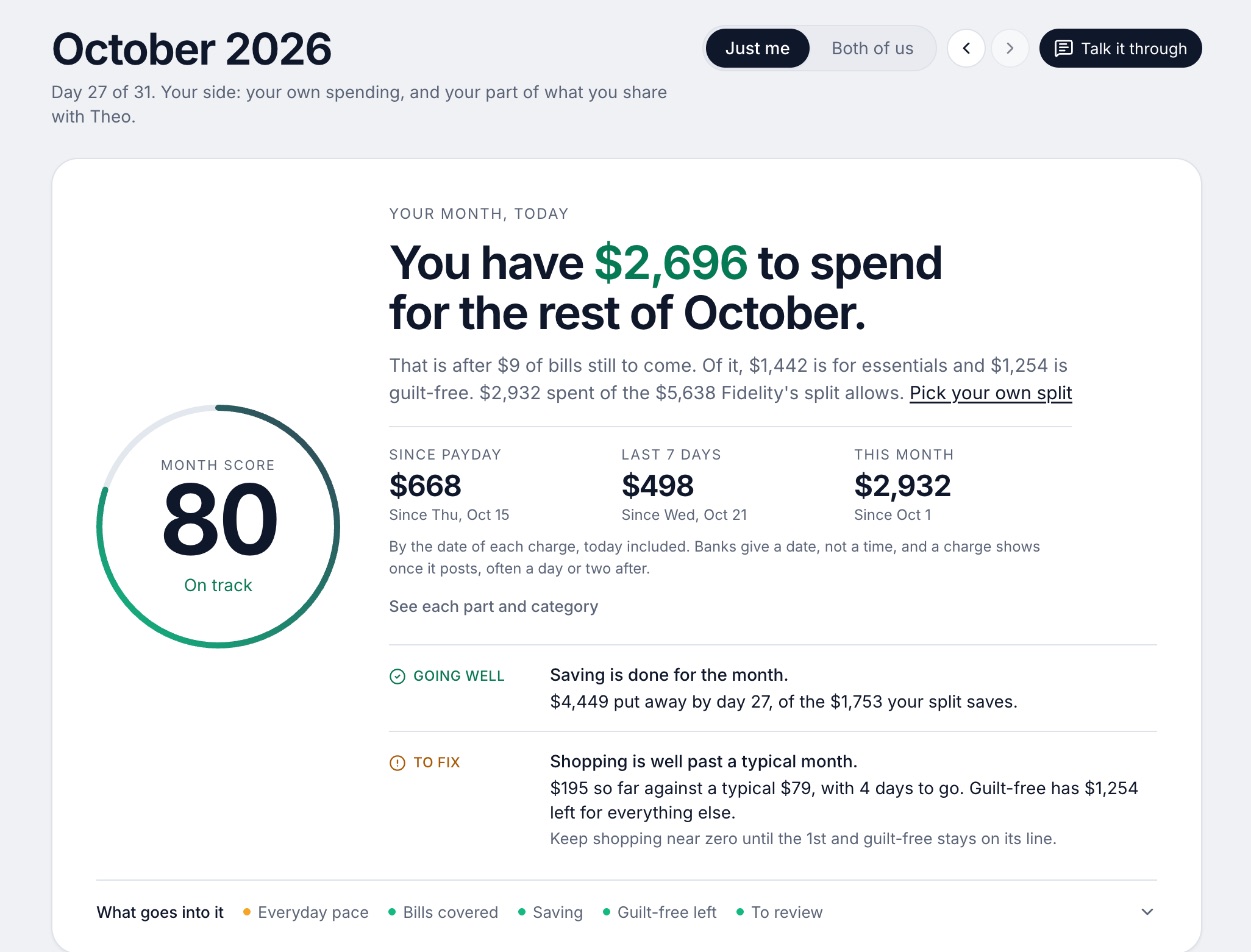
A budgeting app for couples who keep their own money, and for one person: each of you connects your own bank, chooses what the other sees, and every paycheck gets a plan.
Why it's on this list
Wonderful is first because the budget is the part of personal finance that decides your month, and it does that job for one person or two. Every paycheck gets a plan before it lands, and it also shows net worth for each of you and for both, from the balances your banks send. It finds recurring charges and what is due next, and it texts you by iMessage when a bill is charged twice. One subscription covers the household. It runs in the browser, has no investment advice or portfolio analysis, and doesn't cancel subscriptions for you.
Ideal for: One person or a couple who wants every paycheck planned and a view of net worth, and doesn't need investment advice.
What it does
- Every paycheck gets a plan for bills, spending and saving before it lands.[3]
- Banks connect through Plaid and every charge is sorted into a category.[2][3]
- Mine, yours and ours: each charge counts for the person or the pair it belongs to.[3]
- Finds recurring charges and subscriptions, lists what's due before your next paycheck, and flags a bill that comes in higher than usual. It doesn't cancel them for you.[3]
- Texts you by iMessage when a bill is charged twice, a price goes up or a refund lands, and you can text it questions.[3]
- Savings goals show the month you'll reach them.[3]
- Net worth for each of you and for both, from the balances your banks send, with its line over time.[3]
- Life events like getting married come step by step, with the deadlines.[3]
Good
2. Budgeting, net worth and investments in one paid app
What it is
A paid budgeting and net worth app that pulls every account into one place and lets a partner join under the same subscription.
Why it's on this list
Monarch is the closest thing to a standard all-in-one. It connects bank accounts, cards, loans, investment accounts and real estate, tracks net worth, and gives you two ways to budget. It's rated 4.9 on the App Store and 4.8 on Google Play. The catch is the price and the tiers: deeper investment tracking sits in Plus.
Ideal for: People who want budgeting and net worth in one paid app and don't mind a partner seeing everything.
What it does
- Connects bank accounts, credit cards, loans, investment accounts and real estate, through 13,000+ financial institutions.[7]
- Tracks net worth across all connected accounts.[5][7]
- Sorts transactions automatically and searches across every account in one list.[5][7]
- Two ways to budget: Flex, which splits spending into fixed, flexible and non-monthly buckets and gives one main number to watch, or Category budgeting.[5][10]
- Rollovers: money left in a category carries into the next month, to cover bills that do not come every month.[10]
Good
- A partner joins under the same subscription at no extra cost, with a separate login.[8][9]
- Two people can fund a shared goal even when their money sits in separate accounts.[9]
- Works on iPhone, iPad, Android and the web.[5][6][7]
- Rated 4.9 on the App Store (116K ratings) and 4.8 on Google Play (26.1K reviews).[5][6]
Not so good
- No free plan after the first week.[4][5]
- Paid monthly it is $14.99, which is $179.88 over twelve months, against $99.99 billed yearly.[4]
- Forecasting, several income sources and deeper investment tracking sit in the Plus tier. The App Store shows Plus at $199.99 a year; the pricing page lists no Plus price.[4][5]
- A partner sees all accounts and transactions. The couples page describes no way to keep one account private.[8][9]
Pricing
- Monthly[4][5]$14.99 a monthPricing page and App Store both show $14.99. The pricing page does not say which tier it is.
- Yearly[4][5]$99.99 a yearBilled yearly. The pricing page names two tiers, Core and Plus, but lists only these two prices.
- Yearly Plus[4][5]$199.99 a yearShown only as an in-app purchase on the App Store. The pricing page says Plus adds forecasting tools, tracking several income sources like a small business, and deeper investment tracking.
- The pricing page says "Your first week is on us." The App Store says the app is free to try for 7 days before a monthly or annual membership is billed. Neither says whether a card is needed.[4][5]
- No free plan is listed on the pricing page or the App Store. The only free access is the first week.[4][5]
“My wife loves being able to see every thing in one place. It took us 10 years to find this app. Thank you monarch!”Read it where it was said ↗
3. Budgeting by a method, giving every dollar a job
What it is
A paid budgeting app built on a method: give every dollar a job before you spend it.
Why it's on this list
YNAB is a budgeting method first and an app second. Its pages describe reports on net worth over time, and it has a Loan Planner for debt. It belongs on a personal finance list because it covers the job of deciding, before you spend, where each dollar goes.
Ideal for: People who will learn a method and use it every week to stay ahead of their bills.
What it does
- The method: for every dollar, ask "What's it for?" Plan for now (before the next paycheck), for later (non-monthly bills like car repairs), and for ease (get a month ahead).[17]
- Bank import links accounts and brings in transactions automatically. Apple Card import is also listed.[16]
- Targets: set spending and savings goals per category and track progress at a glance.[16]
- Loan Planner: shows how much interest and time you save for each extra dollar paid toward debt.[16][18]
- Reports on spending, such as average grocery spend, and on net worth over time.[16][18]
Good
- A written method, not just a tracker: the app is built around planning before spending.[17]
- One subscription covers up to six people at no extra cost.[15]
- A 34-day trial with no card when you sign up on the site, and a free 365-day trial for college students.[15]
- Rated 4.8 on the App Store (62K ratings) and 4.6 on Google Play (25.4K).[18][19]
Not so good
- No free plan after the trial.[15]
- Paid monthly it is $14.99, which is $179.88 over twelve months, against $109 billed annually.[15]
- The website says a 34-day trial and the App Store says 30 days.[15][18]
- The method asks you to plan each dollar before you spend it, which the company's method page presents as the whole point of the app.[17]
Pricing
“Budgeting works if you want to change your life. In 10 years of using YNAB we went from being a total of $250,000 in debt to $950,000 in net worth. It takes time and commitment to change.”Read it where it was said ↗
4. A polished all-round app on Apple devices and the web
Copilot Money
$13/mo or $95/yr· iPhone, Web, Mac· App Store 4.8 (31K)[26]
What it is
A paid budgeting and net worth app for Apple devices and the web, with an AI money assistant and one plan that does everything.
Why it's on this list
Copilot tracks spending, investments, net worth and subscriptions in one paid plan, with adaptive budgets and an AI Money Assistant. It is on iPhone, iPad, Mac and the web, with no Android app. The website and the App Store show different prices, so check which one you are being shown.
Ideal for: One person on Apple devices who wants budgets, investments and net worth in a polished app.
What it does
- Money Assistant: an AI you can ask about your money. The page says it "always asks before acting." It can fix transactions, run instructions in the background and flag spending trends with budget suggestions. The App Store says it is available only on iPhone.[23][26]
- Connects to 16,000+ US institutions through read-only integrations, with direct links for Venmo, Apple Card and Coinbase.[25][26]
- Sorts transactions automatically, and the assistant can change a category or match a refund to its purchase. You can set your own categories with colors and emojis.[23][26]
- Adaptive budgets that adjust to your spending.[26]
- Tracks spending, investments, net worth and subscriptions.[23][26]
Good
Not so good
- No Android app. The pages list iPhone, iPad, Mac and web only.[23][24][25]
- Sharing with a partner is not live. Households are marked "Coming soon."[23][24][25]
- No free plan after the trial.[25]
- The website and the App Store show different prices: $18 a month or $109 a year (shown as $9 a month) on the site, $13.00 and $95.00 on the App Store.[24][26]
Pricing
- Website, monthly[24]$18 a monthBilled monthly. The pricing page calls it "One simple plan" (checked in a browser 10/27).
- Website, yearly[24]$109 a yearShown as $9 a month, billed yearly, "instead of $119", and labeled a limited time offer.
- App Store, monthly[26]$13 a monthListed as $13.00 on the App Store, which is not what the pricing page shows.
- App Store, yearly[26]$95 a yearListed as $95.00 on the App Store.
“I switched to Copilot when Mint shut down. This app is much better than Mint ever was. The annual fee is a small price to pay to manage my budget and transactions.”Read it where it was said ↗
5. A spending plan with cash flow projections and investment tracking
Quicken Simplifi
$6.99/mo; $3.99/mo the first year· iPhone, Android, Web
What it is
A web and mobile budgeting app from Quicken that links accounts, builds a spending plan, projects cash flow and tracks bills, goals and investments.
Why it's on this list
Simplifi, from Quicken, shows what you can spend per day, projects cash flow with what-if scenarios, and also tracks investments with cost basis. It has no free plan and no trial, only a 30-day money-back guarantee on direct purchases, and it renews at the then-current rate rather than the first-year offer.
Ideal for: People who want a spending plan with a forecast, and investment tracking and a retirement planner in the same subscription.
What it does
- A spending plan that shows what you can spend per day.[28]
- Projected cash flow with "what-if" scenarios.[28]
- Tracks upcoming bills and subscriptions and shows all your subscriptions.[28]
- Automatically categorizes transactions and connects to over 14,000 financial institutions.[28]
- Savings goals, reports and insights.[28]
Good
- A partner can use the shared space without paying for a second subscription.[30]
- 30-day money-back guarantee on purchases made directly from Quicken.[31][32]
- Every support channel is included with every subscription.[29]
- Covers budgeting, bills, investments and a retirement planner in one subscription.[28]
Not so good
- No free plan and no free trial.[32]
- Annual billing only, and renewal is at the then-current rate, not the first-year offer.[28][32]
- Only one shared space and one additional member; no way to share only some accounts.[30]
- A person invited to share must accept on the web app; signing in on the mobile app prompts them to subscribe.[30]
Pricing
- Simplifi, first-year offer[28]$3.99 a monthBilled annually. The page says the final price may differ from the monthly price times 12, and the offer is for the first year when ordered directly from Quicken by November 26, 2026.
- Simplifi, price shown beside the offer[28]$6.99 a monthBilled annually. Shown next to $3.99 on the page without a label. The subscription renews at "the then-current rates".
“Easy to set up. For me it’s great! Tracking my finances - I only have to look in one place for everything. Love it!”Read it where it was said ↗
6. Budgeting, investing, taxes and an AI advisor under one fee
Origin
$99/yr; $1 the first year· iPhone, Android, Web, Mac· App Store 4.6 (3,980)[39]
What it is
A subscription app for iPhone, Android, Mac and web that tracks spending and investments, has an AI advisor, and lets a partner join at no extra cost.
Why it's on this list
Origin goes widest of the paid apps: budgets, an investing view across connected accounts, its own index portfolios, free DIY tax filing and estate planning. A partner is included. Its reviews describe bank connections that expire and billing after cancelling, so check the terms before the $1 first year ends.
Ideal for: People who want budgeting, investing, tax filing and an AI advisor under one flat fee.
What it does
- An AI advisor ("Ask Origin") that answers money questions using your connected accounts. Origin says there are "no usage limits on the AI Advisor".[35][36]
- Tracks spending, cash flow, subscriptions and bills, and builds budgets from your habits.[39]
- Automatic categorization of transactions; you can edit transactions and add new ones.[36]
- Connects accounts through Plaid, MX and Mastercard, and accepts CSV uploads.[36][37]
- Investing view: holdings, allocation and performance across connected brokerage and retirement accounts, plus Origin's own automated index portfolios.[37][39]
Good
- Partner access is included in the price.[36][38]
- Free DIY tax filing is part of the membership, including joint filing.[36][37]
- One flat fee: $99 a year after the first year, with no add-ons for tax filing or partner access.[36]
- Covers budgeting, investing, estate planning and an AI advisor in one app.[35][39]
Not so good
- No free plan or free trial on the pages opened; the first year is $1, then $99 a year.[36][37]
- Many 5-star App Store reviews in 2026 end with "Entered a sweepstakes for this review."[40]
- Origin's claim that its AI Advisor scored 98.3% on the CFP exam is its own marketing and was not checked.[36]
- App Store reviewers in 2026 report bank connections that expire or will not reconnect, and slow support.[40]
Pricing
- First year promotion[36][37]$1 a year"$1 for the first year." Per Origin's blog.
- Annual after year one[36]$99 a year"$99/year", a flat annual fee. Partner access and tax filing carry no add-on.
- Origin's blog says it offers no free trial, only the first-year price: "Try Origin for $1 for your first year." Whether a card is needed was not stated on the pages opened.[37]
- No free plan is described on the pages opened. The App Store listing is free to download, and 2026 reviewers say the app is unusable without a subscription.[39][40]
“My wife and I are able to combine all our accounts here — and see who’s is who’s. It’s got a great AI integration as well.”Read it where it was said ↗
7. Free net worth, investment and retirement views
Empower Personal Dashboard
Free· iPhone, Android, Web· App Store 4.8 (421,639)[46]
What it is
A free dashboard and app that links your bank, card, loan and investment accounts to show net worth, spending and retirement scenarios, paid for by Empower's advisory services.
Why it's on this list
Empower is the free choice for the long view. It links bank, card, loan and investment accounts, and its retirement planner tests different retirement ages. It isn't a budgeting app: its pages describe tracking daily spending and nothing like an envelope or category plan. It is paid for by advisory services, which it offers next to the free tools.
Ideal for: People who mostly want to see net worth, investments and retirement scenarios, and don't need a budget.
What it does
- Net worth: total holdings minus total debts, across accounts in one place, with the effect of paying down debt or saving more.[44]
- Retirement planner: compare retirement ages, see what goals such as college or travel need, and set up withdrawals.[45]
- Budgeting and cash flow: tracks daily spending and expenses; transactions are categorized automatically.[43]
- Portfolio analysis: performance, risk level and where your money is invested.[43]
- Fee Analyzer, to find hidden fees in investment accounts.[48]
Good
- The dashboard and its tools are free.[43]
- Covers retirement and investment accounts, not just bank and card spending.[43][45]
- 4.8 stars on the App Store from 421,639 ratings, for the app that also serves retirement-plan users.[46]
- Includes a Fee Analyzer and a retirement planner that tests different retirement ages.[45][48]
Not so good
- Advisory services are paid for with a fee based on assets under management; the free tools are offered next to them.[42][43]
- The pages describe budgeting only as tracking daily spending; no envelope, zero-based or per-category plan is described.[43]
- Nothing on the pages opened describes a spouse, partner or joint view.[42][43][44][45]
- Its own pages give two different advisory minimums: $100,000 and more than $250,000.[42][43][45]
Pricing
- Personal Dashboard[43]Free"Nothing! The dashboard experience and financial tools are completely free."
- The dashboard and its financial tools are free. The high-yield cash account is described as having "no account fees, no minimums".[43]
“I have used this through my current employer for a few years and it’s steadily become a lot more functional and less buggy”Read it where it was said ↗
8. Finding and cancelling forgotten subscriptions
What it is
An app that finds your subscriptions, can cancel them and negotiate bills for you, and tracks spending and budgets, with a free plan and two paid ones.
Why it's on this list
Rocket Money starts from subscriptions and bills rather than a monthly plan. The free plan finds subscriptions and shows upcoming bills and spending, and Premium adds cancelling for you, net worth and more budgets. It also negotiates bills, for a share of what it saves.
Ideal for: People who suspect they are paying for things they forgot, and want to cancel them first and budget second.
What it does
- Finds recurring subscriptions in one place. On Premium, a team cancels them for you; its cost article says this usually takes 2 to 10 days. On Free you cancel them yourself.[49]
- Negotiates cable, phone and insurance bills for a success fee of 35% to 60% of the first year's savings.[49][50][51]
- Tracks upcoming bills, net income and spending, with automatic categories.[49]
- Custom budgets: two custom category budgets on Free, unlimited custom budgets and categories on Premium.[49]
- Premium adds transaction rules, splits, notes, tags, manual transactions and CSV export.[49]
Good
- A free plan exists and covers subscription tracking, bills and basic budgets.[49]
- Cancels subscriptions for you on Premium and negotiates bills.[49]
- Large installed base: 403K ratings on the App Store at 4.5 stars and 141K on Google Play at 4.5.[52][53]
- Premium is a sliding scale you pick yourself, with a 7-day trial.[49][50]
Not so good
- The price is not fixed: the learn article says $7 to $14 a month, the help center gives no numbers, and the App Store lists purchases from $2.99 to $9.99.[49][50][52]
- Bill negotiation costs 35% to 60% of the first year's savings for Free and Premium members.[49][50]
- On Free you cancel subscriptions yourself. Hands-off cancelling is Premium.[49][51]
- The free plan allows two custom category budgets, so a full budget needs Premium.[49]
Pricing
- Free[49]FreeMobile only. Tracks subscriptions and upcoming bills, with two custom category budgets.
- Premium[49][50][52]Pay what you think is fair, "typically $7 to $14 per month, subject to change," per the learn article. The help center says the price varies by platform and gives no numbers. The App Store lists Premium purchases from $2.99 to $9.99 without billing periods.
- Premium+[49][50][52]$15 a monthA fixed $15 a month plus tax. Adds Rowan, an AI assistant that works through text messages, and no fee on bill negotiation.
- The help center says new Premium members get a 7-day free trial, then the subscription continues at the price chosen at sign-up. The learn article states no trial.[49][50]
- A free plan exists. It links accounts (not in real time), tracks subscriptions but you cancel them yourself, tracks upcoming bills, and shows spending breakdowns.[49]
“I selected 7 dollars per month and it still charged me for 15”Read it where it was said ↗
9. Free net worth, credit alerts and a cash account
What it is
A free app from NerdWallet that tracks net worth and cash flow, sorts spending, and offers a cash account and automated investing.
Why it's on this list
NerdWallet's app is free to download and covers net worth, credit monitoring and a spending split into needs, wants and savings. It also sells a cash account and automated investing, through a partner. Its own app page describes it as a way to track wealth and invest, and doesn't describe category budgets.
Ideal for: People who want a free net worth view and credit alerts, and may use its cash account.
What it does
- A net worth tracker that shows your finances in one view.[56]
- On the App Store: automatically sorts spending into needs, wants and savings.[57]
- Credit monitoring with alerts and an explanation of what affects your score.[57]
- Links accounts to show spending and transactions.[57]
- Finds forgotten subscriptions and bank or savings options.[57]
Good
Not so good
- nerdwallet.com/app describes the app as a way to track wealth and invest, and does not mention budgeting features for it.[56]
- No category budgets or limits are described on the pages opened.[56][57]
- The listing says privacy practices include tracking identifiers across other companies' apps and websites.[57]
- App Store reviewers in 2026 report lost data after accounts unlink, and a removed net worth graph.[58]
Pricing
- The App Store lists the app as Free with no in-app purchases shown.[57]
“...now that I can't see a net worth graph it's not as useful.”Read it where it was said ↗
10. Free credit scores and reports
What it is
A free app for credit scores and reports that also tracks spending and net worth from your linked accounts.
Why it's on this list
Credit Karma is on this list for the one job the others only touch: free credit scores, reports and monitoring. It also tracks spending and has net worth and cash flow views, but its home page names no budgeting tool. Reviewers complain about ads and credit card offers.
Ideal for: People whose main question is their credit score, with a light look at spending as a bonus.
What it does
- Free credit score, credit report and credit monitoring.[60]
- "Get insights into where your money goes by connecting your accounts."[60]
- Tracks monthly spending and automatically categorizes transactions.[61]
- Has Cash Flow and net worth views; the home page does not describe them.[60]
- Free federal tax filing through Credit Karma Tax; state filing is $15.[60]
Good
Not so good
- No budgeting tool is named on the home page; it lists only Cash Flow and a net worth view.[60]
- The home page does not say whether spending insights are free.[60]
- App Store reviewers in October 2026 complain about ads, notifications and credit card offers.[62]
- App Store reviewers in October 2026 say categories they set revert to others, some nightly.[62]
Pricing
- App[61]FreeListed as Free on the App Store.
“...the nightly sync is disrupting my spending categories by resetting them each night”Read it where it was said ↗
11. Desktop software that keeps your data on your computer
What it is
Desktop money software for Windows and Mac, with a companion phone app, that downloads bank transactions, budgets and tracks bills and investments.
Why it's on this list
Quicken Classic is the long-running desktop answer for Windows and Mac, with a companion phone app. It goes furthest on the paperwork side: investing tools, tax reports with export to TurboTax on Premier, and bill pay. It has four tiers and renews at the then-current price.
Ideal for: People who want desktop software that keeps data local and handles investments, bills and tax reports.
What it does
- Links bank and credit card accounts and downloads and categorizes spending automatically.[66]
- Budgets: a simple monthly budget on Starter, multiple budgets on Deluxe.[65][66]
- Tracks upcoming bills and subscriptions; bill pay is on Premier, for "over 10,000 billers".[65][67]
- Investing tools on Deluxe and Premier; Premier calculates IRR and ROI and analyzes buys and sells.[66][67]
- Built-in tax reports with export to TurboTax on Premier.[67]
Good
Pricing
- Classic Starter[66]$4.49 a monthBilled annually. The 40% off does not apply to Starter. No investment tracking.
- Classic Deluxe[64][65]$6.99 a monthBilled annually, shown with 40% off. Multiple budgets, debt reduction, retirement planning. Windows and Mac.
- Classic Premier[64][67]$7.99 a monthBilled annually, down from $8.99 (40% off). Adds investing tools, tax reports and bill pay for over 10,000 billers.
- Classic Business & Personal[64]$10.99 a monthBilled annually, down from $12.49 (40% off). Business and personal finances in one place.
“...annual fee is far too much for the product”Read it where it was said ↗
The all-in-one apps side by side
Monarch, Copilot and Origin are the three that try to be your one app. They overlap a lot, so the differences are worth laying out:
- Monarch is the broadest on accounts. It connects bank accounts, credit cards, loans, investment accounts and real estate, through 13,000+ financial institutions.[7] It runs on iPhone, iPad, Android and the web, and a partner joins under the same subscription.
- Copilot is the most polished and the narrowest on devices. It runs on iPhone, iPad, Mac and the web, not Android.[23][24][25] Its partner sharing is marked coming soon.[23][24][25]
- Origin goes furthest beyond budgeting: its own investment accounts, tax filing and estate planning.[36][37] It is the only one with a $1 first year, then $99.
If you want the most accounts, take Monarch. If you want the cleanest screens and are on Apple devices, take Copilot. If you want the investing and tax side under the same fee, take Origin. Our Copilot vs Monarch and Origin vs Monarch pages go feature by feature.
Which app for which situation
Sometimes the choice is about where you are in life, not about features. A few common ones:
- You're paying down debt. YNAB has a Loan Planner that shows how much interest and time you save for each extra dollar paid.[16][18] Empower has a Debt Paydown tool, free.[43]
- You're thinking about retirement. Empower's planner compares retirement ages.[45] Simplifi has a retirement planner in the same subscription as its budget.[28]
- You have more than one source of income. Monarch's pricing page says its Plus tier adds tracking several income sources like a small business.[4][5]
- You don't trust anything with your bank login. Quicken Classic is desktop software, and its pages say the data stays local.[65]
- You just want to stop overpaying for subscriptions. Rocket Money finds them in one place and, on Premium, cancels them.[49]
- You and a partner each get paid separately. Look at the two-person section below and our couples roundup.
How to set up your money in a month
You don't need every app on this page. A sequence that works for most people:
- Week 1: budget. Pick one budgeting app and link the account you spend from. Let a month of charges come in before you judge anything.
- Week 2: bills. Look at the recurring charges the app found. Cancel the ones you forgot about. Our subscription managers page covers the apps that do this for you.
- Week 3: net worth. Add your savings, investments and debts to a net worth view, in the same app or a free one. Write the number down. The point is the direction over a year, not today's figure.
- Week 4: goals. Pick one thing to save for and set the monthly amount. Our savings apps page compares places to keep it.
What each one shows about your investments
If you invest, this is where the apps differ most. Some only add your balances to net worth. Others analyze the holdings. Here is what each one's own pages say.
- Empower Personal Dashboard: Portfolio analysis: performance, risk level and where your money is invested.[43]
- Origin: Investing view: holdings, allocation and performance across connected brokerage and retirement accounts, plus Origin's own automated index portfolios.[37][39]
- Quicken Simplifi: Investment tracking with cost basis, performance analysis and real-time quotes.[28]
- Quicken Classic: Investing tools on Deluxe and Premier; Premier calculates IRR and ROI and analyzes buys and sells.[66][67]
- NerdWallet: An Automated Investing account, also offered through Atomic Invest.[56]
- Copilot Money: Tracks spending, investments, net worth and subscriptions.[23][26]
- Monarch Money: Connects bank accounts, credit cards, loans, investment accounts and real estate, through 13,000+ financial institutions.[7]
Wonderful counts investments toward net worth as balances. It gives no investment advice or portfolio analysis, so if you want your allocation or fees looked at, pair it with one of the apps above or use the one your brokerage gives you.
Credit scores, and which apps show one
Only a few apps here treat credit as a feature, and they do it differently.
- Credit Karma: Free credit score, credit report and credit monitoring.[60]
- NerdWallet: Credit monitoring with alerts and an explanation of what affects your score.[57]
- Rocket Money: Credit score viewing on Free and full credit report monitoring on Premium.[49]
- Credit Karma: Scores differ from lenders': one reviewer says the app's score is less accurate than the one lenders show.[62]
The other apps on this page don't describe a credit score on the pages we read. Treat any score in an app as a guide, and check the one a lender pulls before you apply.
What reviewers complain about
Features are easy to list. What goes wrong is more useful. These are the reasons the profiles give for people leaving each app, from App Store reviews and the apps' own pages.
- Monarch Money: Connections that drop. App Store reviewers describe accounts that "disconnect all the time" and a bank that stayed broken for a month.[12]
- Copilot Money: Bank connections that fail or will not reconnect. App Store reviews name Bank of America, Fidelity, Merrill and Schwab.[27]
- Empower Personal Dashboard: Stability: App Store reviewers in 2026 report blank screens, crashes after login and long loads.[47]
- NerdWallet: Data loss: reviewers say account history or whole accounts were erased.[58]
- Origin: Connections: reviewers in 2026 say banks disconnect, will not reconnect, or reset an account's value so the history looks wrong.[40]
- Quicken Simplifi: Bank connections: App Store reviewers in 2026 report main banks disconnecting, accounts that will not sync, and long waits for fixes.[34]
- Monarch Money: Billing after cancelling. Several App Store reviews from July to October 2026 say they were billed after they cancelled or found it hard to cancel.[12]
- Origin: Billing: several 2026 reviewers say they were charged a year later or after cancelling and could not reach support.[40]
Dropped bank connections are the first complaint for Monarch, Copilot, Origin and Simplifi, and billing after cancelling comes up for Monarch and Origin. Both are worth checking before you commit. Look at the recent reviews on the App Store, not the average, and pay with a method you can dispute if a cancelled plan keeps billing.
If there are two of you
Most personal finance apps assume one person. What a second person gets varies a lot:
- Wonderful: A partner joins with their own login at no extra cost. One subscription covers the household.[1]
- Monarch Money: A partner joins at no extra cost under the same subscription and gets their own login. The page says, "Partners will each have their own login, but can view each other's data."[8][9]
- Origin: "Origin offers partner access so you can manage your finances together at no additional cost." One partner invites the other by email and each connects their own accounts.[36][38]
- YNAB (You Need A Budget): YNAB Together shares one subscription with up to six people, "for the price of a single subscription." It is meant for partners and other close groups.[15][16][21]
- Quicken Simplifi: Spaces sharing: you can share your data with one additional member. They need their own Quicken ID but not their own subscription, and must accept the invite on the web app.[28][30]
- Copilot Money: Households are marked "Coming soon" and partner invites "coming this fall" on the home and pricing pages. Once live, the pages say up to 3 people share one subscription at no extra cost with full access.[23][24]
- Rocket Money: Account sharing with a partner is listed as a Premium feature.[49]
Our couples roundup covers what a partner can see in each, and the privacy guide goes into hiding an account from a partner.
Two apps that work well together
You don't have to find one app that does everything. Because most of the free ones do a single job, a pair is often cheaper than an all-in-one:
- A budget plus a free net worth view. Use Wonderful, YNAB or Simplifi for the month, and Empower beside it for investments and retirement scenarios. Empower's pages say connecting every account is optional.[43]
- A budget plus a credit score. Keep the budget in one app and look at credit in Credit Karma or NerdWallet, both free to download.
- One all-in-one. Monarch, Copilot or Origin if you would rather keep one login and one list of accounts and don't mind paying for it.
If you are choosing between the budgeting apps, our Monarch vs YNAB comparison is the one people ask for most.
Before you connect a bank
Every app here asks you to link accounts, so a few questions are worth asking first. What does it say about how it reaches your bank? Rocket Money says your bank logins go straight to Plaid and are not stored by Rocket Money,[51] and Copilot describes read-only integrations with 16,000+ US institutions.[25][26] Does it show ads, or sell what it sees? Copilot's FAQ says it does not sell financial data, and Origin's App Store listing says it never sells data.[25][39] Can you cancel without a call? Look for the cancel steps on the app's own page before you start a trial.
Then link one account first, check the transactions look right, and add the rest. A budget built on a feed that is wrong is worse than no budget.
How to choose
Pick the job first. If you are not sure, start with a budget.
Choose Wonderful if you:
- Want every paycheck planned, alone or as a couple
- Want net worth next to the plan
- Don't need investment advice
- Are fine with a web app for now
Choose Monarch Money if you:
- Want budgeting and net worth in one app
- Are fine paying about $100 a year
- Want a partner to join at no extra cost
Choose YNAB (You Need A Budget) if you:
- Want a method, not just a tracker
- Will plan every week
- Are in debt and want a loan planner
Choose Copilot Money if you:
- Use only Apple devices
- Want a polished app with investments and net worth
Choose Origin if you:
- Want budgeting, investing and tax filing in one fee
- Want an AI advisor in the app
Choose Empower Personal Dashboard if you:
- Mostly want to watch net worth and retirement
- Want it free and can ignore advisor offers
Choose Credit Karma if you:
- Mainly want a free credit score
- Can live with ads and card offers
Choose Quicken Classic if you:
- Want desktop software with data kept local
- Need tax reports and bill pay
Where Wonderful fits, and where it doesn't
We make Wonderful, so here is its place plainly. It does the budget well: a plan for every paycheck, for one person or a couple, with net worth next to it. It doesn't do the rest of this page. It gives no investment advice, shows investments only as balances, shows no credit score, and finds subscriptions without cancelling them. If you want a free net worth and retirement view, use Empower beside it. If you want a credit score, use Credit Karma. If you need an iPhone or Android app today, Wonderful doesn't have one yet. For cancelling subscriptions, see the subscription managers comparison.
Questions people ask
What is the best personal finance app?
It depends on the job. For planning every paycheck, Wonderful, YNAB and Simplifi. For one app that covers budgeting, net worth and investments, Monarch or Copilot. For free net worth and retirement scenarios, Empower. For credit scores, Credit Karma. Most people need one budgeting app and, if they invest, one place that shows the whole picture.
What is the difference between a budgeting app and a personal finance app?
A budgeting app is about this month: what came in, what went out and what is left. A personal finance app is wider. It can also show net worth, investments, retirement scenarios, credit and bills. Some apps do both. Our roundup of the best budgeting apps goes deeper on the first job.
Is there a free personal finance app?
Yes. Empower's dashboard and tools are free, NerdWallet's app is listed as free on the App Store, and Credit Karma is free to download. Rocket Money has a free plan, but a full budget needs Premium. Empower pays for the free tools with advisory services, and NerdWallet's Cash Account earns it referral fees, so read what the free app is there to offer.
Which personal finance app is best for net worth?
Empower is free and built around net worth and retirement scenarios. Monarch, Copilot and Origin show net worth next to a budget and are paid. Wonderful shows net worth for each person and for both, from the balances your banks send. Our net worth trackers page compares them in more detail.
Which app is best for budgeting and investing together?
Monarch and Copilot track both under one paid plan. Origin adds its own investment accounts and an AI advisor for $99 a year after a $1 first year. Simplifi tracks investments with cost basis and has a retirement planner. Wonderful shows investments as balances in net worth and gives no investment advice.
How much do personal finance apps cost?
From free to about $200 a year (Monarch Plus, as the App Store lists it). Empower, NerdWallet and Credit Karma are free to use. Simplifi's first-year offer is $3.99 a month billed annually. Monarch is $99.99 a year and YNAB $109 billed annually. Wonderful is $14.99 a month or $99 a year for the whole household. Check each app's page before you pay.
Are personal finance apps safe?
They connect to your bank through a data provider and read your accounts. Rocket Money says bank logins go straight to Plaid and aren't stored, and Copilot describes read-only integrations. No app can promise nothing will ever go wrong, so use a unique password and turn on two-step sign-in wherever it is offered.
Which personal finance app is best for couples?
Look at what a partner sees. Monarch, Origin, YNAB and Wonderful include a partner under one subscription, and Simplifi shares one space with one other person. Our couples roundup compares what each partner sees and how shared bills are split.
Do I need more than one personal finance app?
Many people do. One app for the monthly plan and one for the long view is common: a budgeting app plus a free net worth tracker, or a budgeting app plus a credit score app. The all-in-one apps, Monarch, Copilot and Origin, try to do both so you only keep one.
What are the alternatives to Mint?
Our Mint alternatives page lists 13 apps like Mint and what each does differently. Several of the apps here, including Monarch, YNAB and Copilot, are on it.
Sources
70 sources · read October 27, 2026
Every number on this page comes from wonderful.money, monarch.com, apps.apple.com and 16 more. If a source has changed since, the source is right.
- 1Wonderful terms of servicewonderful.money
- 2Wonderful privacy policywonderful.money
- 3Wonderfulwonderful.money
- 4Monarch pricingmonarch.com
- 5Monarch on the App Storeapps.apple.com
- 6Monarch on Google Playplay.google.com
- 7Monarch home pagemonarch.com
- 8Monarch for couplesmonarch.com
- 9Monarch collaborationmonarch.com
- 10Monarch budgetingmonarch.com
- 11Monarch planningmonarch.com
- 12Apple public review feed for Monarchitunes.apple.com
- 13Monarch help: Monarch for Couples and Householdshelp.monarch.com
- 14Trustpilot, www.monarchmoney.comtrustpilot.com
- 15YNAB pricingynab.com
- 16YNAB featuresynab.com
- 17The YNAB methodynab.com
- 18YNAB on the App Storeapps.apple.com
- 19YNAB on Google Playplay.google.com
- 20Apple public review feed for YNABitunes.apple.com
- 21YNAB: Using YNAB as Partnerssupport.ynab.com
- 22Trustpilot, ynab.comtrustpilot.com
- 23Copilot Money homecopilot.money
- 24Copilot Money pricingcopilot.money
- 25Copilot Money FAQcopilot.money
- 26Copilot on the App Storeapps.apple.com
- 27Apple public review feed for Copilotitunes.apple.com
- 28Quicken Simplifi product pagequicken.com
- 29Quicken blog: personal finance software with the best customer supportquicken.com
- 30Simplifi help: How to use Spaces sharingsupport.simplifi.quicken.com
- 31Simplifi help: How to cancel and get a refundsupport.simplifi.quicken.com
- 32Simplifi help: Subscription questionssupport.simplifi.quicken.com
- 33App Store listing, Quicken: Budget & Track Moneyapps.apple.com
- 34App Store reviews, Quicken: Budget & Track Moneyapps.apple.com
- 35Origin home pageuseorigin.com
- 36Origin blog: Why Origin is the best personal finance app in 2026useorigin.com
- 37Origin blog: Why Origin is the best all-in-one AI finance appuseorigin.com
- 38Origin blog: Finance apps that let you add a partner in 2026useorigin.com
- 39App Store listing, Origin: AI Budget and Trackapps.apple.com
- 40App Store reviews, Originapps.apple.com
- 41Origin legal pageuseorigin.com
- 42Empower home pageempower.com
- 43Empower tools pageempower.com
- 44Empower net worth toolempower.com
- 45Empower retirement plannerempower.com
- 46App Store listing, Empowerapps.apple.com
- 47App Store reviews, Empowerapps.apple.com
- 48Empower free tools pageempower.com
- 49Rocket Money: How much does Rocket Money costrocketmoney.com
- 50Rocket Money help center: How much does Rocket Money costhelp.rocketmoney.com
- 51Rocket Money FAQframer.rocketmoney.com
- 52Rocket Money on the App Storeapps.apple.com
- 53Rocket Money on Google Playplay.google.com
- 54Apple public review feed for Rocket Moneyitunes.apple.com
- 55Trustpilot, rocketmoney.comtrustpilot.com
- 56NerdWallet app pagenerdwallet.com
- 57NerdWallet: Smart Money App on the App Storeapps.apple.com
- 58App Store reviews feed for NerdWallet (most recent)itunes.apple.com
- 59Trustpilot, nerdwallet.comtrustpilot.com
- 60Credit Karma homecreditkarma.com
- 61Intuit Credit Karma on the App Storeapps.apple.com
- 62App Store reviews feed for Intuit Credit Karma (most recent)itunes.apple.com
- 63Trustpilot, creditkarma.comtrustpilot.com
- 64Quicken plans and pricingquicken.com
- 65Quicken Classic Deluxequicken.com
- 66Quicken Classic Starterquicken.com
- 67Quicken Classic Premierquicken.com
- 68Quicken Classic companion app on the App Storeapps.apple.com
- 69Trustpilot: quicken.comtrustpilot.com
- 70App Store reviews feed for Quicken Classic (most recent)itunes.apple.com
App names are trademarks of their owners; Wonderful isn't connected with them. Wonderful gives general information. It isn't a financial or tax advisor.