The short version
For irregular income, YNAB is the app built around living on last month's money, and Goodbudget does the same with envelopes and has a free plan. Cushion plans freelance work and invoices but is not a budget. Wonderful, which we make, plans each paycheck, but its pages don't say it handles pay that changes in size.
- 1
YNAB (You Need A Budget): Living on last month's money, with a 34-day trial
- 2
Goodbudget: A one-month cushion and envelopes, with a free plan
- 3
Monarch Money: Forecasting several income sources, on the Plus tier
- 4
Quicken Simplifi: A plan that counts pay you expect later in the month
- 5
Cushion: Planning freelance work and invoices, not spending
- 6
Tiller: A spreadsheet you shape around your own pay
- 7
Lunch Money: Budget periods you set to match when you get paid
- 8
Wonderful: A plan for each paycheck; not built for uneven pay
How to manage irregular income
An app can't make an uneven paycheck even. What works, in the sources below, is a short list of habits. The apps in this page are ways to keep them.
- Budget the money you have, not the money you expect. YNAB's guide says to create your plan on a baseline of about $5,000. In its example you earn $8,700 in March, assign $5,000 to that month's categories, and set the other $3,700 aside for later.[7]
- Build a cushion, then pay from it. Goodbudget's help page calls pooling income into a one month cushion the ideal solution, then using it to fund your envelopes all at once at the start of the month. Its irregular paychecks article suggests two or three months of expenses when pay is very unpredictable.[9][8]
- Plan week by week when timing is the problem. The CFPB's cash flow budget tracks the timing of income and expenses to make sure you have enough from week to week: start with the week's balance, add the income that week, subtract the expenses, and carry the ending balance into the next week.[1]
- Pay the fixed bills first. Rent, insurance and loan payments come before anything flexible. Our fixed expenses list and sinking funds guide cover the yearly and quarterly bills that catch uneven earners out.
- Set tax money aside the day you are paid. If you are self-employed, the IRS says you generally have to make estimated tax payments when you expect to owe $1,000 or more. More on that below.[2]
If you are in a couple, uneven pay also changes who pays what. Our guide to uneven incomes in couples covers six ways to share costs when one of you earns less, and split bills by income shows the arithmetic. If you are short right now, see apps for living paycheck to paycheck.
At a glance
| App | Price | Free trial | For irregular income | Works on |
|---|---|---|---|---|
| YNAB (You Need A Budget) | $14.99/mo or $109/yr | The pricing page says a 34-day free trial | Guide: baseline, set the surplus aside, fund next month | iPhone, Android, Web |
| Goodbudget | Free, or $10/mo or $80/yr | None stated | Help: a one-month cushion in Available, fill envelopes monthly | iPhone, Android, Web |
| Monarch Money | $14.99/mo or $99.99/yr | The pricing page says "Your first week is on us | Plus tier: forecasting and several income sources | iPhone, Android, Web |
| Quicken Simplifi | $6.99/mo; $3.99/mo the first year | "While we do not offer a free trial" there is a 30-day money-back guarantee from the original purchase date | Plan counts income received and expected this month | iPhone, Android, Web |
| Cushion | $18/mo or $180/yr | 14-day free trial | Goals at three levels; income spread across a project's months | Web |
| Tiller | $99/yr | 30 days free | A spreadsheet you build; tracks solo business income | Web |
| Lunch Money | $10/mo or $100/yr | A 30-day free trial | Budget periods that match your pay cycle | iPhone, Web |
| Wonderful | $14.99/mo or $99/yr | A free week | Not stated for uneven pay amounts | Web |
How we compared
Uneven income puts different strain on an app than a steady salary does. So we looked at five things:
- Does it plan from money in hand. An app that asks for next month's pay to build a budget works against you.
- Can it hold a cushion. A place for extra money to wait, so it can cover a lean month.
- Can it look ahead. Bills due soon, a forecast, or a calendar.
- What it costs, and whether there is a trial. Pay that swings makes a fixed monthly fee matter more.
- What it leaves out. Taxes and invoices are not in most of these apps, and we say so.
Every fact comes from the CFPB and IRS pages named in the sources, from each app's pricing and help pages, and from Cushion's own site, all read on November 3, 2026. We haven't used these apps ourselves. Where a page didn't say, we say it didn't. For the wider list, see best budgeting apps.
1. Living on last month's money, with a 34-day trial
What it is
A paid budgeting app built on a method: give every dollar a job before you spend it.
Why it's on this list
YNAB's irregular income guide is the plainest version of the method above. It builds the plan on a baseline, sets the surplus from big months aside, and uses a large payment to fund the next month or two.[7] Its method also has a step to get a month ahead.[13]
It costs $14.99 a month or $109 a year after a 34-day trial. The App Store says 30 days. It has no tax tools; the guide we read doesn't mention taxes.
Ideal for: Freelancers and gig workers who will do the weekly work of assigning each payment as it arrives.
What it does
- The method: for every dollar, ask "What's it for?" Plan for now (before the next paycheck), for later (non-monthly bills like car repairs), and for ease (get a month ahead).[13]
- Bank import links accounts and brings in transactions automatically. Apple Card import is also listed.[12]
- Targets: set spending and savings goals per category and track progress at a glance.[12]
Good
- A written method, not just a tracker: the app is built around planning before spending.[13]
- One subscription covers up to six people at no extra cost.[11]
- A 34-day trial with no card when you sign up on the site, and a free 365-day trial for college students.[11]
- Rated 4.8 on the App Store (62K ratings) and 4.6 on Google Play (25.4K).[14][15]
Not so good
- No free plan after the trial.[11]
- Paid monthly it is $14.99, which is $179.88 over twelve months, against $109 billed annually.[11]
- The website says a 34-day trial and the App Store says 30 days.[11][14]
- The method asks you to plan each dollar before you spend it, which the company's method page presents as the whole point of the app.[13]
2. A one-month cushion and envelopes, with a free plan
Goodbudget
Free, or $10/mo or $80/yr· iPhone, Android, Web· App Store 4.6 (13,522)[24]
What it is
An envelope budgeting app for the web, iPhone and Android where you divide income into virtual envelopes and share the budget across devices.
Why it's on this list
Goodbudget's help page tells you to pool income into a one month cushion, keep it in Available until you assign it to an envelope, and fund the envelopes at the start of the month.[9]
The free plan has 10 regular envelopes, 10 annual or goal envelopes, 1 account, 2 devices and 1 year of history, and you enter transactions yourself. Premium adds US bank sync and costs $10 a month or $80 a year.[19][20]
Ideal for: People who like envelopes, want to start free, and will hold a month of expenses in Available.
What it does
- Envelope budgeting: you divide income into category envelopes, spend from the matching envelope and stop when it is empty, with no physical cash.[26]
- The free plan has 10 regular envelopes and 10 annual or goal envelopes; Premium removes the cap.[19][20]
- Syncs and shares a budget across iPhone, Android and the web, with data backed up to Goodbudget's website.[22][24]
- Automatic bank sync is a Premium feature and works with US banks only. The free plan is manual entry.[19][20]
Good
Pricing
- Free[19][20]FreeCalled "Free Forever" on the page. 10 regular envelopes, 10 annual or goal envelopes, 1 account, 2 devices, 1 year of history, debt tracking, community support.
- Premium[19][20]$10 a month · $80 a yearAdds automatic bank sync (US banks only), unlimited envelopes and accounts, 5 devices, 7 years of history and email support.
3. Forecasting several income sources, on the Plus tier
What it is
A paid budgeting and net worth app that pulls every account into one place and lets a partner join under the same subscription.
Why it's on this list
Monarch's Flex budgeting gives one main number to watch, and rollovers carry money left in a category into the next month.[29][34] The part aimed at uneven earners is the Plus tier: the pricing page says it adds forecasting tools, tracking several income sources like a small business, and deeper investment tracking. That page lists no Plus price; the App Store shows Plus at $199.99 a year.[28][29]
Core is $14.99 a month or $99.99 a year after a free week. A partner joins under the same subscription.[28][29][32][33]
Ideal for: People with several income streams who will pay for forecasting and want a partner to see the same data.
What it does
- Connects bank accounts, credit cards, loans, investment accounts and real estate, through 13,000+ financial institutions.[31]
- Tracks net worth across all connected accounts.[29][31]
- Sorts transactions automatically and searches across every account in one list.[29][31]
- Two ways to budget: Flex, which splits spending into fixed, flexible and non-monthly buckets and gives one main number to watch, or Category budgeting.[29][34]
Good
- A partner joins under the same subscription at no extra cost, with a separate login.[32][33]
- Two people can fund a shared goal even when their money sits in separate accounts.[33]
- Works on iPhone, iPad, Android and the web.[29][30][31]
- Rated 4.9 on the App Store (116K ratings) and 4.8 on Google Play (26.1K reviews).[29][30]
Not so good
- No free plan after the first week.[28][29]
- Paid monthly it is $14.99, which is $179.88 over twelve months, against $99.99 billed yearly.[28]
- Forecasting, several income sources and deeper investment tracking sit in the Plus tier. The App Store shows Plus at $199.99 a year; the pricing page lists no Plus price.[28][29]
- A partner sees all accounts and transactions. The couples page describes no way to keep one account private.[32][33]
Pricing
- Monthly[28][29]$14.99 a monthPricing page and App Store both show $14.99. The pricing page does not say which tier it is.
- Yearly[28][29]$99.99 a yearBilled yearly. The pricing page names two tiers, Core and Plus, but lists only these two prices.
- Yearly Plus[28][29]$199.99 a yearShown only as an in-app purchase on the App Store. The pricing page says Plus adds forecasting tools, tracking several income sources like a small business, and deeper investment tracking.
- The pricing page says "Your first week is on us." The App Store says the app is free to try for 7 days before a monthly or annual membership is billed. Neither says whether a card is needed.[28][29]
- No free plan is listed on the pricing page or the App Store. The only free access is the first week.[28][29]
4. A plan that counts pay you expect later in the month
Quicken Simplifi
$6.99/mo; $3.99/mo the first year· iPhone, Android, Web
What it is
A web and mobile budgeting app from Quicken that links accounts, builds a spending plan, projects cash flow and tracks bills, goals and investments.
Why it's on this list
Quicken says the Simplifi spending plan includes income you've already received and income you expect later in the month, and lists people with variable or irregular income among those it suits. It updates as transactions download.[10] Its help article doesn't explain how it estimates expected income when your pay varies, so treat that part as something to try in the trial.
Simplifi lists $3.99 or $6.99 a month billed annually, with no free trial and a 30-day money-back guarantee on purchases made on Quicken.com.[43]
Ideal for: Employees with variable hours or commissions who want a spending plan that adjusts as money arrives, at a low price.
What it does
- A spending plan that shows what you can spend per day.[39]
- Projected cash flow with "what-if" scenarios.[39]
- Tracks upcoming bills and subscriptions and shows all your subscriptions.[39]
Good
- A partner can use the shared space without paying for a second subscription.[41]
- 30-day money-back guarantee on purchases made directly from Quicken.[42][43]
- Every support channel is included with every subscription.[40]
- Covers budgeting, bills, investments and a retirement planner in one subscription.[39]
Not so good
- No free plan and no free trial.[43]
- Annual billing only, and renewal is at the then-current rate, not the first-year offer.[39][43]
- Only one shared space and one additional member; no way to share only some accounts.[41]
- A person invited to share must accept on the web app; signing in on the mobile app prompts them to subscribe.[41]
Pricing
- Simplifi, first-year offer[39]$3.99 a monthBilled annually. The page says the final price may differ from the monthly price times 12, and the offer is for the first year when ordered directly from Quicken by November 29, 2026.
- Simplifi, price shown beside the offer[39]$6.99 a monthBilled annually. Shown next to $3.99 on the page without a label. The subscription renews at "the then-current rates".
5. Planning freelance work and invoices, not spending
Cushion
$18/mo or $180/yr· Web
What it is
A web app for solo freelancers that plans work and income by month, with goals, a year-long schedule, invoicing and time tracking. It is not a budgeting app.
Why it's on this list
Cushion is on this list for the income side, which budgeting apps skip. You set goals at minimum, target and stretch, and its graph spreads a project's estimated income over the months the project runs. A project you haven't scheduled doesn't show up in the monthly graph.[46][48]
It is not a budget. Its pages mention no bank connection, bills or tax tools. Pro is $15 a month billed annually after a 14-day trial with no card. Its changelog shows an update every month from March to July 2026.[47][49]
Ideal for: Solo freelancers who want to see months ahead which work and income they expect, and who budget their spending somewhere else.
What it does
- Goals that separate what you need to earn from what you want to earn, at minimum, target and stretch levels, drawn on a budget graph for the year.[46][48]
- A yearly schedule that shows availability and overbooking months ahead and flags delays.[46]
- Spreads a project's estimated income across the months it runs, so a three-month job shows in each of them. A project that isn't scheduled doesn't show in the monthly graph.[48]
- Client insights on payment and delay patterns, shown when you schedule or estimate a project.[46]
- Invoicing and accepting payments, and time tracking with reports, are in the same plan.[47]
Good
- Built around uneven income: goals at three levels and a month-by-month view of income you expect.[46][48]
- 14-day trial with no card, and no auto-subscribe at the end.[47]
- Actively updated: the changelog has an entry for each month from March to July 2026.[49]
- Invoices, time and the forecast live in one place.[47]
Not so good
- Not a budget: the pages we read mention no bank connection, spending categories or bills.[46][49]
- Pages mention nothing about taxes or setting money aside for them.[46][49]
- Geared to solo freelancers. Teams use it with one person managing the account, and no household or partner feature is listed.[47]
- No mobile app yet; it is a web app, and the API is private.[47]
Pricing
- Pro, billed annually[47]$180 a yearListed as $15 a month billed annually, so $180 a year. Supporter ($20) has the same features as Pro; Subsidized ($10) is "Discounted for those who need it" and the page states no eligibility rules.
- Pro, billed monthly[47]$18 a monthListed as $18 a month billed monthly.
“Mainly a scheduling/forecasting app but has some great, newer features around invoicing/payments and time tracking.”Read it where it was said ↗
6. A spreadsheet you shape around your own pay
Tiller
$99/yr· Web
What it is
A service that sends your bank transactions into Google Sheets or Excel spreadsheets you own, with budget templates on top.
Why it's on this list
Tiller is a spreadsheet, not a method. It sends bank transactions into Google Sheets or Excel daily, sorts them with AutoCat, and its features include tracking solo business income, expenses and profit. You can build the CFPB's week-by-week cash flow budget in it, or a baseline-and-cushion sheet. That is work you do. It is $99 a year after 30 free days, with 30 more days backed by a refund.[51][52]
Ideal for: Freelancers who are comfortable in a spreadsheet and want their own bank feed.
What it does
- Syncs bank accounts into private spreadsheets you own, with daily automation.[51]
- All transactions flow into one Transactions Sheet.[51]
- Works with both Google Sheets and Microsoft Excel.[53]
- AutoCat sorts transactions into categories, and you can set your own category rules.[51][53]
Good
Pricing
- Tiller[52]$99 a year"After 30 days, Tiller is just $99/year." The only plan listed; no monthly option shown.
7. Budget periods you set to match when you get paid
Lunch Money
$10/mo or $100/yr· iPhone, Web· App Store 4.8 (58)[60]
What it is
A web budgeting app that pulls in bank transactions, with rules, recurring items, multi-currency support and unlimited contributors to a budget.
Why it's on this list
Lunch Money connects banks through Plaid and lets you set custom budget periods that match your pay cycle. If you are paid on the 20th, or when clients pay, the budget does not have to start on the 1st. It has a calendar view of income and expenses, and recurring items that match imported transactions. It is $10 a month or $100 a year, with a 30-day trial and no card.[58][57]
Ideal for: People who are paid on their own schedule and want the budget month to match it.
What it does
- Connects to bank and credit card accounts through Plaid so transactions pull in automatically.[57][58]
- Also takes manual entry and CSV imports, and manual accounts for cash, assets, gift cards and crypto.[57]
- Custom budget periods that match your pay cycle.[58]
- A rules engine that categorizes transactions based on conditions you set.[58]
Good
Not so good
- Current prices could not be confirmed: the pricing page returned HTTP 403 when we tried it.[56]
- The pages opened show no iOS or Android app.[57]
- Bank syncing goes through Plaid, and the guide says to open bank syncing tickets from the in-app support menu when something breaks.[57]
- Not envelope budgeting: a Hacker News commenter says its philosophy is "fundamentally different from YNAB".[59]
8. A plan for each paycheck; not built for uneven pay
Wonderful
$14.99/mo or $99/yr· Web
What it is
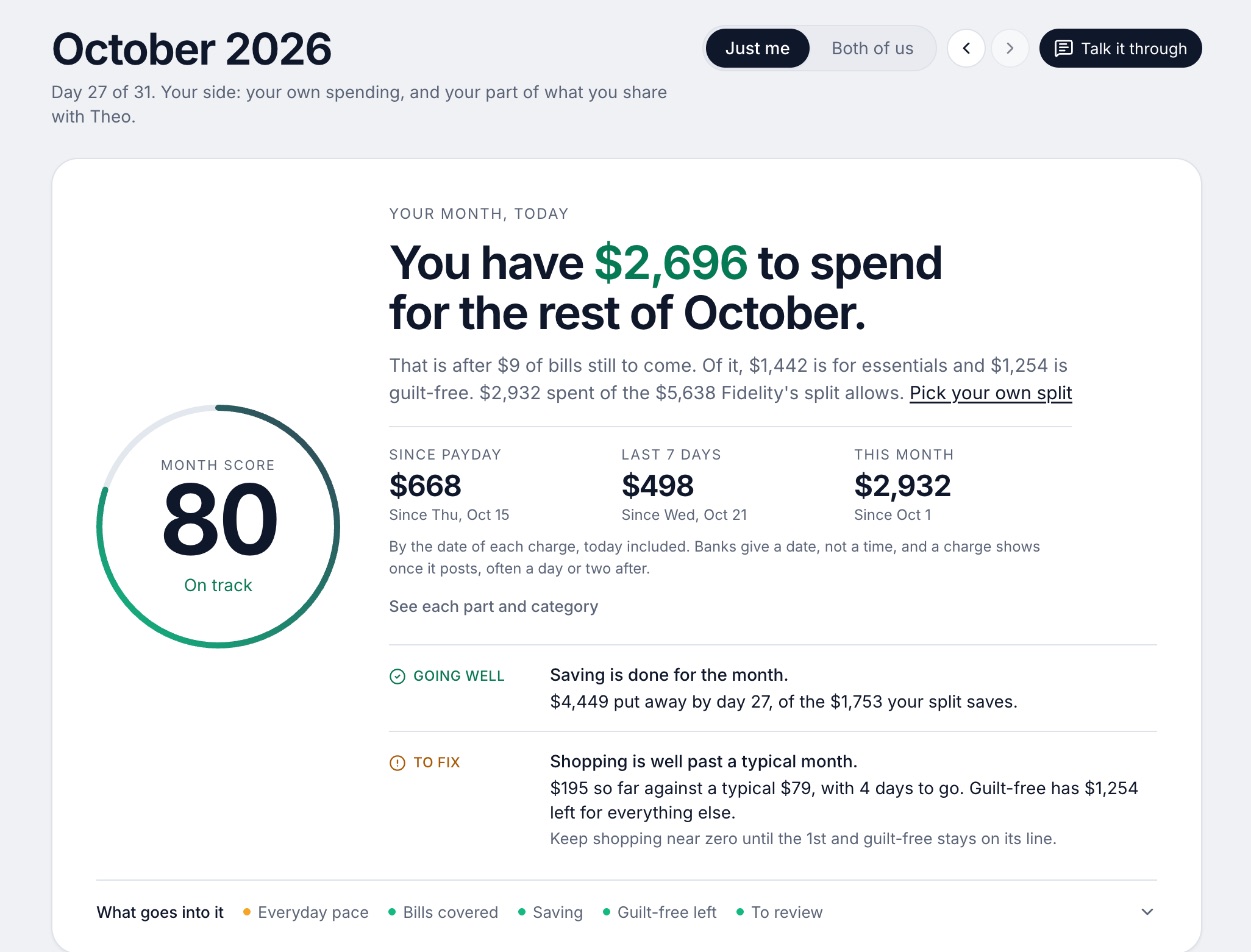
A budgeting app for couples who keep their own money, and for one person: each of you connects your own bank, chooses what the other sees, and every paycheck gets a plan.
Why it's on this list
We make Wonderful, and it is a weak fit for this page. Its pages say every paycheck gets a plan for bills, spending and saving, and that it lists what is due before your next paycheck. They don't say it handles pay that changes in size from one payment to the next, so we won't claim it does. If your pay swings a lot, YNAB, Goodbudget or Cushion are the better places to start.
It fits a narrower case: a household where one or both of you get steady paychecks on different schedules, and you want each one planned. It is not free: a free week, then $14.99 a month or $99 a year for the household. See budgeting apps for weekly, biweekly and monthly pay for that case.
Ideal for: People whose pay arrives in steady paychecks (even if on different days), who want it planned bill by bill. Not people whose pay swings widely.
What it does
- Every paycheck gets a plan for bills, spending and saving before it lands.[64]
- Banks connect through Plaid and every charge is sorted into a category.[63][64]
- Mine, yours and ours: each charge counts for the person or the pair it belongs to.[64]
- Finds recurring charges and subscriptions, lists what's due before your next paycheck, and flags a bill that comes in higher than usual. It doesn't cancel them for you.[64]
- Texts you by iMessage when a bill is charged twice, a price goes up or a refund lands, and you can text it questions.[64]
- Savings goals show the month you'll reach them.[64]
- Net worth for each of you and for both, from the balances your banks send, with its line over time.[64]
- Life events like getting married come step by step, with the deadlines.[64]
Good
Setting tax money aside
The pages we read for these apps describe no tax calculator, and Cushion's mention none. So the rule is a habit, not a feature. When a payment lands, move a share to a separate account before you plan the rest.
- Who pays. Sole proprietors, partners and S corporation shareholders generally have to make estimated tax payments if they expect to owe $1,000 or more when their return is filed.[2]
- When. Four installments. The IRS lists income from January through March as due April 15, April and May as due June 15, June through August as due September 15, and September through December as due January 15. For 2026 those are April 15, June 15 and September 15, 2026, and January 15, 2027. A weekend or holiday moves the date to the next business day.[3][5]
- How much. Form 1040-ES is the worksheet, and the IRS suggests using last year's return as a guide. You generally avoid the underpayment penalty by paying at least 90% of this year's tax or 100% of last year's, whichever is smaller.[2]
- Self-employment tax. The IRS says the rate is 15.3% (12.4% Social Security and 2.9% Medicare), and it applies when your net earnings from self-employment are $400 or more.[6]
- Lumpy income. The IRS says payments are generally made in four equal amounts, and that taxpayers with uneven income may be able to adjust them using the annualized installment method. Its Annualized Estimated Tax Worksheet is in Publication 505.[4][3]
This is general information, not tax advice. A tax professional can tell you what your numbers should be, and the IRS pages above are the source for the rules.
What it costs for a year
- Goodbudget$80
- Quicken Simplifi$83.88
- Tiller$99
- Wonderful$99
- Monarch Money$99.99
- Lunch Money$100
- YNAB (You Need A Budget)$109
- Cushion$180
From each app's own pages. Goodbudget is the Premium plan; its free plan costs nothing. Simplifi is the lower listed price, billed annually. Monarch is Core; Plus costs more. Cushion is Pro billed annually. Wonderful's yearly price covers both partners.
How to choose
Start with the problem. If bills sneak up on you in lean months, you need the cushion habit, and YNAB or Goodbudget are built around it. If the problem is knowing what work is coming, that is Cushion. If you mostly want to see what is due and when, any of the bank-connected apps will list it.
Choose YNAB (You Need A Budget) if you:
- Want to live on last month's money
- Will assign each payment when it arrives
- Can pay $109 a year after a 34-day trial
Choose Goodbudget if you:
- Want to start free and use envelopes
- Are fine entering transactions by hand
- Want a one-month cushion in Available
Choose Monarch Money if you:
- Have several income sources
- Will pay for Plus to get forecasting
- Want a partner on the same subscription
Choose Quicken Simplifi if you:
- Have variable hours but a fairly steady base
- Want a low price and a plan that updates
- Don't need a trial
Choose Cushion if you:
- Freelance alone
- Want to see income by month before it arrives
- Will budget spending in another app
Choose Tiller if you:
- Like building in a spreadsheet
- Want to keep your own data
- Want to track solo business income
Choose Lunch Money if you:
- Get paid on your own schedule
- Want the budget month to follow it
- Want a web app with rules
Choose Wonderful if you:
- Get steady paychecks on different schedules
- Want each one planned for bills and saving
- Don't need it to forecast uneven pay
Where Wonderful fits, and where it doesn't
If your pay swings from month to month, Wonderful is not the first thing to try. Its pages say each paycheck gets a plan, that it lists what is due before your next paycheck, and that it flags a bill that comes in higher than usual. They don't say it forecasts or smooths uneven pay. It has no free plan after the first week, runs in the browser only, and gives no investment advice.
It is a better fit if you get steady paychecks and want each planned, or you are a couple who keep your own accounts. See budgeting apps for couples, best budgeting apps and the emergency fund guide for the cushion.
Questions people ask
How do you manage irregular income?
Plan from money you already have, not from money you expect. Cover bills and basics first, move the extra from good months into a cushion, and pay yourself from the cushion on a steady day. The CFPB's version is a week-by-week cash flow budget that carries each week's ending balance into the next. If you are self-employed, set tax money aside as each payment lands.
How do you budget when your income changes every month?
Pick a baseline amount you can count on and budget only that, as YNAB's guide does with $5,000 in a month that brought in $8,700. The $3,700 left over is set aside for later months. Goodbudget's help page says the same thing another way: pool income into a one-month cushion, then fill envelopes once at the start of the month.
What is the best budgeting app for irregular income?
For living on last month's money, YNAB, whose own irregular income guide describes the method. For a free start, Goodbudget's envelopes and its one-month cushion advice. For planning freelance work and invoices rather than spending, Cushion. None of them removes the need for a cushion; they help you build and watch one.
How big should the cushion be when income is uneven?
Goodbudget's irregular paychecks article says to build about one month of expenses so you can budget from last month's income, and two or three months if income is very unpredictable. Our emergency fund guide covers how much to keep for a true emergency, which is a separate pot.
Do I have to pay estimated taxes on freelance income?
Generally yes, if you expect to owe $1,000 or more when you file, per the IRS. Payments are due in four installments. For 2026 the IRS lists April 15, June 15 and September 15, 2026, and January 15, 2027. This is general information, not tax advice; the IRS page and Form 1040-ES have the rules, and a tax professional can check your case.
How do I avoid an underpayment penalty on estimated tax?
The IRS says you generally avoid it if you owe less than $1,000 after withholding and credits, or if you pay at least 90% of this year's tax or 100% of last year's, whichever is smaller. The prior-year figure rises to 110% when last year's adjusted gross income was over $150,000. If your income is lumpy, the IRS also describes an annualized method in Publication 505.
Is Cushion a budgeting app?
No. Cushion's pages describe goals, a yearly schedule, invoicing and time tracking for solo freelancers, and say nothing about connecting a bank account. Use it to plan the income side, and an app such as YNAB, Goodbudget or Monarch for the spending side. It costs $15 a month billed annually, after a 14-day trial with no card.
Is there a free budgeting app for irregular income?
Goodbudget has a free plan: 10 regular envelopes, 10 annual or goal envelopes, 1 account, 2 devices and 1 year of history, with manual entry. Its help pages describe holding income in Available as a cushion. The paid apps here all offer a trial, from Lunch Money's 30 days to YNAB's 34.
Can I use a spreadsheet instead of an app?
Yes. The CFPB's cash flow budget is a worksheet: starting balance, income that week, expenses that week, ending balance, then copy it forward. Tiller sends your bank transactions into Google Sheets or Excel for $99 a year if you want that feed. Our printable monthly budget template is a free start.
Does Wonderful work for irregular income?
Its pages don't say. Wonderful says it plans each paycheck for bills, spending and saving, lists what is due before your next paycheck and flags a bill that comes in higher than usual. It makes no statement about pay that changes in size. If your pay swings widely, try YNAB or Goodbudget first.
- Best apps for living paycheck to paycheck →
- Best zero-based budget apps →
- Best envelope budgeting apps →
- Best budgeting apps for weekly, biweekly and monthly pay →
- How much should you have in an emergency fund? →
- Sinking funds →
- Free paycheck budget planner →
- When one partner earns more: 6 ways to make sharing fair →
Sources
64 sources · read November 3, 2026
Every number on this page comes from files.consumerfinance.gov, irs.gov, ynab.com and 17 more. If a source has changed since, the source is right.
- 1CFPB: Creating a cash flow budgetfiles.consumerfinance.gov
- 2IRS: Estimated taxesirs.gov
- 3IRS: Estimated tax FAQirs.gov
- 4IRS: Tax Topic 306, Penalty for underpayment of estimated taxirs.gov
- 5IRS: 2026 Form 1040-ESirs.gov
- 6IRS: Self-employment taxirs.gov
- 7YNAB: Irregular income guideynab.com
- 8Goodbudget: New to irregular paychecks? Start heregoodbudget.com
- 9Goodbudget help: Handle multiple or variable incomesgoodbudget.com
- 10Quicken Simplifi: Understanding your Spending Planinfo.quicken.com
- 11YNAB pricingynab.com
- 12YNAB featuresynab.com
- 13The YNAB methodynab.com
- 14YNAB on the App Storeapps.apple.com
- 15YNAB on Google Playplay.google.com
- 16Apple public review feed for YNABitunes.apple.com
- 17YNAB: Using YNAB as Partnerssupport.ynab.com
- 18Trustpilot, ynab.comtrustpilot.com
- 19Goodbudget pricing (signup page)goodbudget.com
- 20Goodbudget help: Subscribe to Goodbudgetgoodbudget.com
- 21Goodbudget refunds and cancellationsgoodbudget.com
- 22Goodbudget home pagegoodbudget.com
- 23Goodbudget help indexgoodbudget.com
- 24App Store listing, Goodbudgetapps.apple.com
- 25App Store reviews, Goodbudgetapps.apple.com
- 26Goodbudget envelope budgeting pagegoodbudget.com
- 27Goodbudget changeloggoodbudget.com
- 28Monarch pricingmonarch.com
- 29Monarch on the App Storeapps.apple.com
- 30Monarch on Google Playplay.google.com
- 31Monarch home pagemonarch.com
- 32Monarch for couplesmonarch.com
- 33Monarch collaborationmonarch.com
- 34Monarch budgetingmonarch.com
- 35Monarch planningmonarch.com
- 36Apple public review feed for Monarchitunes.apple.com
- 37Monarch help: Monarch for Couples and Householdshelp.monarch.com
- 38Trustpilot, www.monarchmoney.comtrustpilot.com
- 39Quicken Simplifi product pagequicken.com
- 40Quicken blog: personal finance software with the best customer supportquicken.com
- 41Simplifi help: How to use Spaces sharingsupport.simplifi.quicken.com
- 42Simplifi help: How to cancel and get a refundsupport.simplifi.quicken.com
- 43Simplifi help: Subscription questionssupport.simplifi.quicken.com
- 44App Store listing, Quicken: Budget & Track Moneyapps.apple.com
- 45App Store reviews, Quicken: Budget & Track Moneyapps.apple.com
- 46Cushion homecushionapp.com
- 47Cushion pricingcushionapp.com
- 48Cushion blog: Monthly incomecushionapp.com
- 49Cushion changelogcushionapp.com
- 50Hacker News comments mentioning Cushionhn.algolia.com
- 51Tiller hometiller.com
- 52Tiller pricingtiller.com
- 53Tiller featurestiller.com
- 54Hacker News search for Tiller Money commentshn.algolia.com
- 55Lunch Money help center welcomesupport.lunchmoney.app
- 56Lunch Money blog: The Least Annoying Price Increase in History (Oct 16, 2024)lunchmoney.app
- 57Lunch Money help center: Getting startedsupport.lunchmoney.app
- 58Lunch Money blog: 11 Lunch Money Features You Should Be Usinglunchmoney.app
- 59Hacker News search for Lunch Money commentshn.algolia.com
- 60Lunch Money on the App Storeapps.apple.com
- 61Lunch Money pricinglunchmoney.app
- 62Wonderful terms of servicewonderful.money
- 63Wonderful privacy policywonderful.money
- 64Wonderfulwonderful.money
App names are trademarks of their owners; Wonderful isn't connected with them. Wonderful gives general information. It isn't a financial or tax advisor.